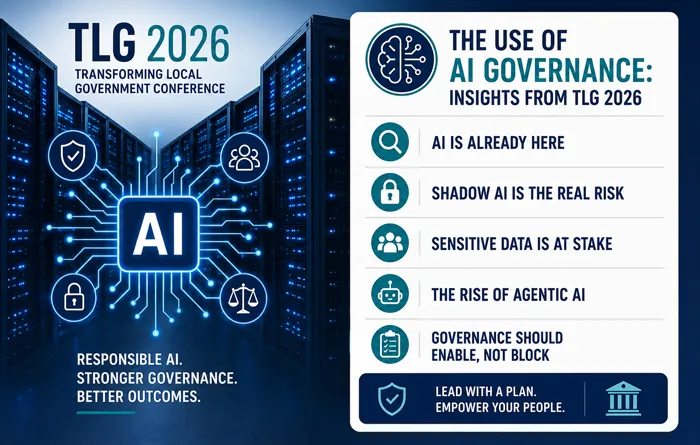
A closer look at responsible AI governance from the 2026 Transforming Local Government Conference
Among the many sessions at TLG 2026 that generated hallway conversation long after the room cleared, Dustin Haisler’s stood out. It took a hard but honest look at an issue top of mind for many attendees: AI governance.
Haisler is the Chief AI Officer and U.S. General Manager of Darwin AI. He spent 12 years at e.Republic advising state and local governments on technology modernization and served as CIO and assistant city manager of the City of Manor, Texas — long recognized as an innovative local government technology shops. When he talks about AI in government, it’s from the perspective of someone who has sat in the chair.
His session—Scaling AI Responsibly: Guardrails That Enable, Not Block, Innovation—opened with a show of hands. How many people in the room used ChatGPT or another AI model on a daily basis? Nearly every hand went up. Haisler smiled. “Those of you not raising your hand are lying.”
The room laughed. But the framing was deliberate. The debate about whether AI is in government, he said, is over.
“Whether AI is in your agency—that debate is already settled,” he said. “Because it’s already there.”
The question is whether leadership knows what’s running, what it’s touching, and what happens next.
The 75-14 gap
Haisler’s firm works with more than 40 state and local government agencies, and the data they’ve compiled is difficult to ignore. The typical agency environment isn’t running two or three AI tools. It’s running 300-plus—most of them invisible to the IT department. About half of those are AI quietly embedded inside applications the agency already licenses. The other half are standalone platforms: ChatGPT, Claude, Perplexity, Grammarly, Canva Magic Write.
The governance picture is starker still. Seventy-five percent of agencies are using AI in some form. Only 14 percent have sufficient governance in place to manage it. That’s a 5.4x disparity. That’s not a future risk. It’s the current operating condition.
A survey from the Center for Digital Government put a finer point on it: 90 percent of government employees are using AI tools with no formal policy in place. Not to circumvent the organization—but because it helps them do their jobs.
“The best way to boost shadow AI is to tell employees this is your one approved tool, this is all you can use,” Haisler said. “What are they going to do? They’re going to find something that actually helps them.”
That’s not insubordination. It’s human nature. And it carries real consequences. Darwin’s data shows that sensitive identifiers are actively flowing into unapproved tools—driver’s license numbers account for 72.7 percent of high-risk Personal Identifying Information (PII) exposure detected in government environments, bank account numbers for another 18 percent. Not because anyone intended to expose citizen data, but because someone was trying to summarize a document and didn’t think about what was in it.
The AI note-takers compound the problem. Otter.ai, Fireflies, Read.ai, Zoom’s AI Companion—all of them transcribe and store meeting content in third-party clouds, often without explicit approval or even awareness. Haisler described sitting in a meeting where four AI note-takers had joined autonomously.
“I’m like, OK, I’ll just talk to your note-takers,” he joked.
If those meetings involve HR matters, legal discussions, or anything sensitive, there’s a records exposure whether anyone recognized it or not.
The agentic shift
The governance challenge is about to get considerably more complex, and Haisler didn’t soften the picture.
The AI landscape has moved through three waves. Wave 1 was generative AI: prompt in, answer out. Wave 2 was copilot AI: AI embedded in tools, helping staff write and summarize. Wave 3, which is arriving now, is agentic AI: systems that don’t wait to be asked. They take autonomous action toward a goal, maintain persistent memory, connect to external systems, and operate with delegated authority. Every major technology company—OpenAI, Anthropic, Google, Microsoft, Meta, Apple—is building this capability, and the tools are already available to government employees and constituents alike.
Haisler demonstrated one: an open-source agent called OpenClaw, running on a Mac Mini at home. He gave it ten research topics. Every morning it does independent research, cross-references what it’s already told him, and delivers a briefing to his phone via WhatsApp. It noticed, unprompted, that he hadn’t ordered his son a birthday present.
The government-facing implications are concrete. A citizen tells her personal AI agent: “Handle my garage permit.” The agent researches the city’s website, identifies required forms and fees, completes the application, navigates the city portal, submits documents, pays the fee, monitors for revision requests, and schedules the inspection. To the city, it looks like a permit application—a well-filled-out one.
Haisler tested this live. He asked an agent to submit public comment in support of a project in Austin. “It found the citizen public input site and made up (the fact that) Dustin jogs that road every single day. I did not jog that road. It made up all of this stuff, created an address and then it submitted it before I could stop.”
The implications for public participation, citizen comment processes, and service delivery are significant. Websites are being scraped by agents that don’t navigate menus—they parse HTML for structured data. Citizen comment portals can be flooded with agent-submitted input that can’t be authenticated. Security models built to verify one human per login have no framework yet for an AI agent acting on behalf of a citizen.
“Each service will see citizens arriving with agents within 12 to 18 months,” Haisler said.
Whether government systems are ready to meet them is the question every local government leader in the room left with.
Guardrails as accelerator
The instinctive response to all of this—and Haisler acknowledged it—is a blanket ban. No AI allowed. Approved tools only. But that’s precisely the policy that creates shadow AI. Employees don’t become less productive because a memo says so. They find workarounds.
Effective governance, in his framing, has three interdependent components.
• Visibility is the foundation. You can’t govern what you can’t see. That means continuously monitoring AI usage across the network — not just tools the agency purchased, but tools staff are using in browsers, on personal devices, and embedded in existing software. It means detecting which prompts are transmitting sensitive data to unapproved destinations.
• Policy that works is specific and enforceable—not a set of abstract principles drafted once and filed away. It names approved tools. It names prohibited data categories. It establishes a process and timeline for getting new tools sanctioned. It addresses what AI agents are and aren’t permitted to do on behalf of staff and citizens. It specifies consequences.
• Enablement is what’s most often missing. Providing safe alternatives—enterprise-licensed tools, use-case libraries, prompt guides organized by role, a champions network, continuous training—is what reduces demand for shadow AI.
“Don’t just block,” Haisler said. “Provide safe defaults so staff stop reaching for something else.”
A guardrail, in this framing, is not a 30-page PDF nobody reads, a committee that meets twice a year, or a procurement process with a six-month timeline. Those are the conditions that generate shadow AI. A real guardrail is what lets more people use more tools, safely.
“The agencies that scale AI fastest will be the ones with the clearest guardrails,” Haisler said, “because they’re the ones their staff, citizens, and auditors can trust.”
What attendees took away
The closing session reflection at TLG captured what resonated. “Govern your AI use before it gets out of hand,” wrote one attendee. Others named the tension directly: “Invest time in AI” appeared alongside “Human component is more important than ever”—a balance the session held honestly rather than resolving too neatly.
That tension is appropriate. The goal isn’t to slow adoption. It’s to make adoption durable—built on visibility, accountability, and the kind of organizational trust that holds up when the first hard question comes.
Local governments don’t have the luxury of watching from the sidelines while the private sector figures AI out. Their constituents are already using it. Their employees are already using it. The only question left is whether leadership is going to shape what that looks like—or respond to what it became.
This is the second in AFI’s series of articles drawn from the 2026 TLG Conference. Dustin Haisler can be reached at dustin@darwingov.com.


Sign up to gain access to our network of innovators to receive updates on emerging trends and AFI research. Stay informed on the forces shaping local government. new snippet of text