Open Space: Where the Real Conversations Happen
Hauson Le, Strategy and Foresight Director for the Alliance for Innovation, set the stakes higher during the TLG Open Space Session in Dallas. What was about to happen, he told the room, was “the beginning of the conversation, not the end.” That’s Open Space in a sentence. Rather than presenting a fixed agenda for participants to absorb, Open Space Technology hands the microphone—and the responsibility—directly to the people in the room. Leaders surface the issues that are keeping them up at night, form groups around shared urgency, and get to work. No presentations. No slides. Just practitioners talking to practitioners about what matters.
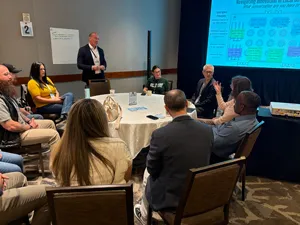
Before the Open Space Technology session kicked off on the morning of April 21, Darin Atteberry, CEO of SGR and the former city manager of Fort Collins, Colo., offered a framing that would have been right at home in any of TLG’s more polished sessions: “Innovation is driven by leadership and culture.”
The format reflects something AFI has understood since 1979: the collective intelligence of local government leaders is one of the field’s most underutilized assets. Open Space doesn’t just recognize that intelligence—it puts it to work.
At the conference, five distinct conversations emerged, and the range of topics was itself a kind of diagnostic. Taken together, they revealed what local government is grappling with in 2026: artificial intelligence in nearly every dimension, the persistent frustration of systems that don’t serve the people who use them, the perennial challenge of getting residents meaningfully engaged, and underneath it all, a deep ongoing conversation about what it actually takes to change an organization.
AI, from every angle
One group was anchored in artificial intelligence, and its work says something important: AI is not one challenge, it is several.
It tackled procurement—how do you bring AI tools into a government organization responsibly? The concerns were practical and pointed: contract management processes that aren’t built for the speed of AI deployment, ERP integration headaches, the challenge of building internal expertise fast enough, and specific use cases like 911 transcription that carry real stakes. Their solutions were equally concrete—training pipelines, subject matter experts embedded in departments, clear policies and guardrails, and protected space for testing through pilot programs and internal labs.
Then there’s the vendor relationship itself, wrestling with a tension that runs through much of government technology: developers often don’t understand how local government actually operates, which means the software they build doesn’t fit the work. One bright spot emerged in the notes—a partnership in which the city of Vail co-developed software with a vendor,
collaborating on three city-wide initiatives and customizing a code enforcement tool that worked as needed. The lesson wasn’t that vendor partnerships are bad; it was that they require genuine collaboration, not just procurement.
Then there’s the foundational question of data governance: what policies and standards need to be in place before any of the AI conversations make sense? The discussion covered data governance boards, the commitment required of data stewards, the thorny question of structured versus unstructured data, and the classic government tension between hosted cloud solutions and on-premises infrastructure.
The ERP problem
One discussion convened around a feeling so widely shared it barely needed a title: “We want to love our ERP.” Enterprise resource planning systems are the operational backbone of most local governments, and the frustration was palpable. The core complaint wasn’t about the software per se—it was about the disconnect between the engineers who build and implement these systems and the staff who live in them every day. When responsiveness is low, the impression that settles in is that the vendor simply doesn’t care. Manual workarounds proliferate. Reporting migrates to Excel. Gaps in the big picture go unaddressed, and errors pile up. The group’s proposed remedy: appeal to technology partners to truly understand the inefficiencies—and use red-team exercises to surface them before they calcify.
Getting to the residents
Another group took on citizen engagement from a refreshingly operational angle, moving quickly past the why and into the how. Their list of outreach channels was a useful inventory: proactive 1:1 outreach, 311 and customer service, postcards, yard signs, robocalls, short outbound videos, council touchpoints, online information and education, and open town halls where residents could speak directly with a manager. The underlying message was one that has appeared across TLG sessions for years—residents don’t engage because government doesn’t meet them where they are, and in the right format, with the right information.
Talking data
One discussion went deeper into data—specifically, how data can support better decisions, not just better reports. The topics: performance KPIs, budgeting and forecasting, waste reduction, performance coaching, resource allocation, caseload and geographic distribution, and leadership decision-making. These aren’t aspirational concepts; they’re the operational infrastructure that makes everything else possible.
The big one: obstacles to innovation
The largest group of the morning gathered around a topic that could have encompassed the entire conference: what gets in the way of innovation in local government? Their notes stretched across four pages and traced a pattern that will be familiar to anyone who has tried to lead change in a public organization.
The obstacles they named were honest: ego, complacency, the comfort of “we’ve always done it this way.” The “innovation hump,” i.e., the gap between deciding to change and changing, where most initiatives die. The way siloed thinking is often driven not by malice but by fear: fear of shame, fear of making mistakes in public, fear that there aren’t enough resources to go around, and even a kind of job-security anxiety that comes from being “married” to a particular piece of software.
But the conversation didn’t stop at diagnosis. The group also interrogated what it looks like to solve the problem. How do you get people to show up as authentic solvers rather than performers? Walking toward chaos rather than away from it. Bringing elected officials along rather than working around them. Recognizing that the systems themselves sometimes create arbitrary obstacles—and that a fresh perspective can reveal those obstacles as optional rather than fixed.
One exchange captured something important: the difference between thinking yourself into a new way of acting versus acting yourself into a new way of thinking. Innovation academies in Bend, Denver, Johnson County, and Elk Grove—all featured elsewhere at TLG—are built on exactly that second insight. You don’t wait for the culture to change before you start. You start, and the culture follows.
The group also surfaced a practical tool: leadership development roundtables with 20 participants, including an exercise in which division heads were asked to identify someone who could take their role within 10 years. The recommended reading: Performance is the Best Politics, available digitally.
What Open Space reveals
Open Space Technology is not a break from the conference’s programming. It is, in many ways, the program. The sessions that follow are richer because participants have already surfaced what they need. The connections made at the flip chart paper carry into the hallway, the lunch table, and the flight home.
For AFI, it is also a kind of proof of concept. An organization committed to helping local governments think differently doesn’t just teach the methods—it models them. Open Space is a reminder that the future of local government isn’t going to be designed in any single keynote. It’s going to be worked out, conversation by conversation, by the people in the room.
And that’s exactly why AFI doesn’t limit Open Space to the conference floor. The format is a regular feature of AFI’s Member Meetup series—virtual gatherings where members bring their own topics, form breakout groups around shared priorities, and move between conversations as the energy leads them. The next one is scheduled for June 18 at noon PT / 2pm CT. The format mirrors what happened in Dallas: a brief introduction, an agenda-setting round, 30 minutes of open conversation, and a debrief. Registration is open now.
For those who want to stay connected between meetups, AFI’s Alliance Circle is the place to do it. It’s where members track upcoming events, continue conversations that started at conferences, and find others working through similar challenges. You can join the Circle here.
The conversation Hauson Le opened in Dallas doesn't have to end when the conference does. That's kind of the point.

Sign up to gain access to our network of innovators to receive updates on emerging trends and AFI research. Stay informed on the forces shaping local government. new snippet of text