Strategic Foresight


Innovation capacity is what enables local governments to remain resilient, adaptive, and forward-thinking.
- Alliance members receive one virtual Strategic Foresight Workshop each year. This session introduces Bill Sharpe’s Three Horizons framework—a practical way to balance today’s demands with the need to anticipate change. Participants diagnose the present, explore what’s possible, and surface the innovations needed to drive transformation.
- Alliance Virtual Foresight workshops provides on-demand training designed to help members lead conversations that introduce strategic foresight and showcase its impact on innovation, strategy, decision-making, culture, and leadership. ALL staff within a member organization may access On-Demand training within the Alliance Member Circle. Each training features practical applications and a discussion guide to connect the value of foresight to day-to-day activities.
- The Alliance Member Circle offers on-demand training to help members lead conversations and apply foresight in their work. All staff in member organizations have access. Each session includes practical tools and discussion guides that connect foresight to strategy, decision-making, culture, and leadership.
- The Alliance offers a Strategic Foresight Certification three times per year through a nine-week virtual program. Members receive two seats annually (a $4,000 value). Participants apply core foresight tools to a topic of their choice, including domain mapping, trend analysis, implications mapping, scenario planning, and strategic options.
Strategic Foresight Workshop
Alliance members receive one virtual Strategic Foresight Workshop each year. This workshop introduces the Three Horizons Framework, a structured approach to balancing the demands of current operations with the foresight needed to anticipate change and adapt proactively.
Expect a strategic conversation diagnosing the present, imagining the possible, and surfacing the innovations necessary to ignite transformation.
Contact Hauson Le to schedule your workshop.
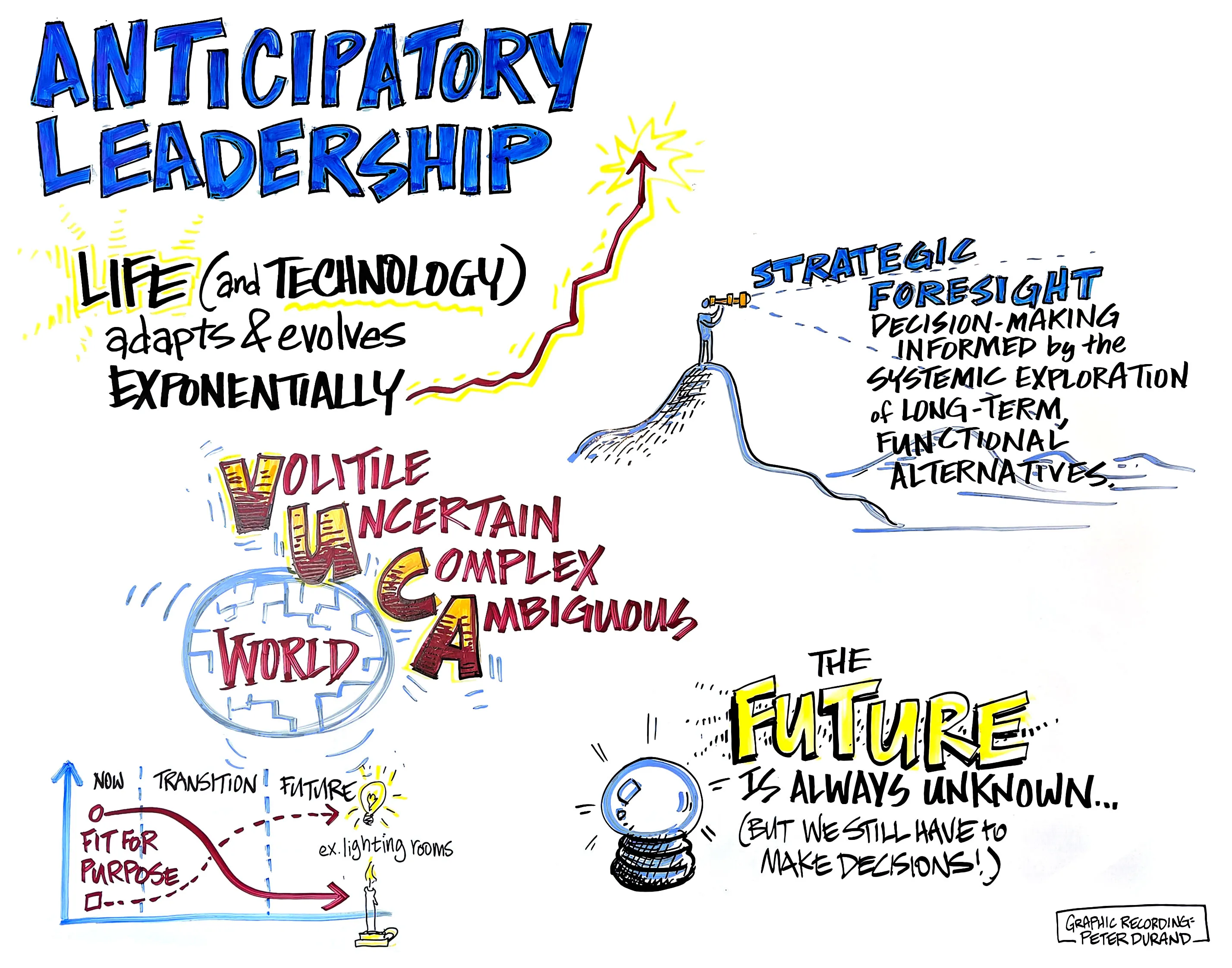
Today’s times for local government are volatile. Budgets are tightening. Expectations are rising. Polarization hasn’t taken a holiday. And AI is reshaping the landscape in ways no one fully understands yet. Decision-making based solely on past experience isn’t enough anymore.
That’s why more cities are turning to strategic foresight, not to predict the future, but to prepare for multiple futures, and to make better decisions in the present.
And one of the simplest, most useful tools in the foresight world is something called the Three Horizons Framework.
And it works because it makes something big feel manageable. As futurist Hauson Le puts it, the framework gives leaders a lens to “see how systems are changing over time, what’s losing fit for purpose, and what’s emerging that could shape the next era.”
And it works because it makes something big feel manageable. As futurist Hauson Le puts it, the framework gives leaders a lens to “see how systems are changing over time, what’s losing fit for purpose, and what’s emerging that could shape the next era.”
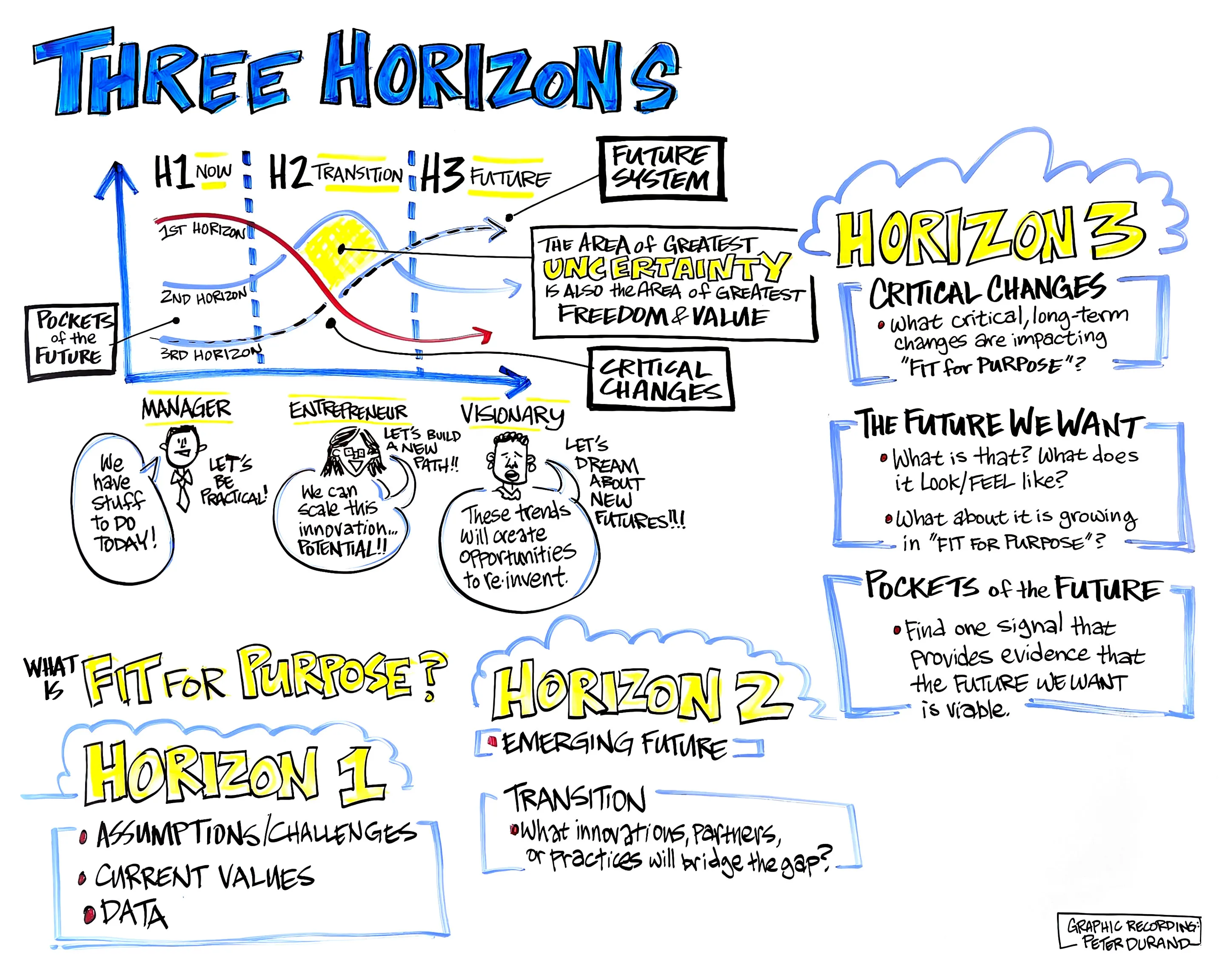
A key benefit is the order of 1st, 3rd, and then 2nd horizon. When we take time to imagine the future we want, the system of the future, the new normal, we then view available partners, practices and innovations with the future operating assumption in mind to help us transition faster. If we don’t do this, innovations can easily and unintentionally perpetuate the status quo.
But here’s the part that matters for local government: all three horizons exist at the same time! You still have to run the city of today while preparing for the city you want.
Become Certified in the Fundamentals of Foresight
Two times each year, the Alliance for Innovation offers members the opportunity to earn certification in Strategic Foresight through a structured four-month virtual learning experience designed specifically for local government professionals. This program moves beyond theory to help participants apply foresight tools directly to real challenges facing their organizations and communities.
Alliance members receive two complimentary seats annually in the certification program, representing approximately $4,000 in professional development value. The Alliance Certification course makes it possible for organizations to build internal foresight capacity that supports long-term planning, innovation, and anticipatory governance.

By the end of the program, participants will be prepared to introduce new approaches to creating change, cultivate shared language for navigating uncertainty, and strengthen an organizational culture that anticipates and shapes the future.
The Alliance for Innovation Strategic Foresight Certification helps local government leaders move from reacting to change toward shaping what comes next.
On-Demand Foresight Training
Alliance On-demand foresight training is designed to help members lead conversations that introduce strategic foresight and showcase its impact on innovation, strategy, decision-making, culture, and leadership. Each 20 minute training features practical applications and a discussion guide to connect the value of foresight to day-to-day activities.
The Art of Anticipation
This introduction outlines the need for anticipation and explains how foresight is the cornerstone for thriving, resilient organizations in the 21st Century. Through guided discussions and shared insights, participants will gain a better understanding of foresight and how it can support their organization to navigate uncertainty.
Foresight Fueled Innovation
Discover how strategic foresight fuels innovation by broadening sources of inspiration, strengthening strategic thinking, and unleashing collective creativity. Learn how foresight can help you better incorporate long-term perspective, change across industries, and anticipation into how leaders in your organization respond to change. By contrasting business-as-usual innovation with foresight-fueled approaches, you will see how foresight shifts solutions from short-term fixes toward more adaptive, future-ready outcomes.
Leading Through Uncertainty
Strategic foresight helps leaders navigate uncertainty by staying aware of change, understanding ripple effects, and stretching thinking. Learn how to shift from minimizing to embracing uncertainty through the application of horizon scanning, the Implications Wheel, and scenario planning. Leading Through Uncertainty shows how to reduce surprise, make sense of complexity, and lead with greater clarity.
Shaping Anticipatory Culture
Strategic foresight shapes anticipatory culture by incorporating to a learning orientation, enabling proactive collaboration, and integrating diverse perspectives across the organization. It shifts culture from seeking the right answer to asking better questions, from reacting to issues to exploring them before they become urgent, and from relying on individual expertise to learning across the system. Through proactive exploration of emerging issues using tools such as the Futures Triangle, Shaping Anticipatory Culture shows how foresight can help build shared understanding, strengthen trust, and create space for collective learning.
Decisions Beyond Certainty
Strategic foresight strengthens decision-making beyond certainty by expanding what informs decisions, testing ideas against change, and revealing hidden assumptions. It helps leaders move from relying only on past data to considering multiple futures, pressure testing strategies through wind tunneling, and reframing challenges using tools like the Futures Cone and Causal Layered Analysis. You will learn how to make decisions that account for uncertainty, align with long-term change, and create space for genuinely distinct strategic options.
Foresight Meets Strategy
Foresight Meets Strategy shows how to incorporate collective wisdom in shaping strategy, prepare for disruption through real-world cases of scenario planning, and explore genuinely distinct pathways aligned with a shared vision. Foresight helps leaders balance what works with what’s needed, turning strategy from a set of marching orders into a shared effort where people across the organization act as stewards of the future.
This members-only training provides a practical introduction to strategic foresight that helps local government leaders strengthen anticipatory governance, organize the “messy middle” of change, and make more confident decisions in a rapidly evolving environment.

Sign up to gain access to our network of innovators to receive updates on emerging trends and AFI research. Stay informed on the forces shaping local government. new snippet of text