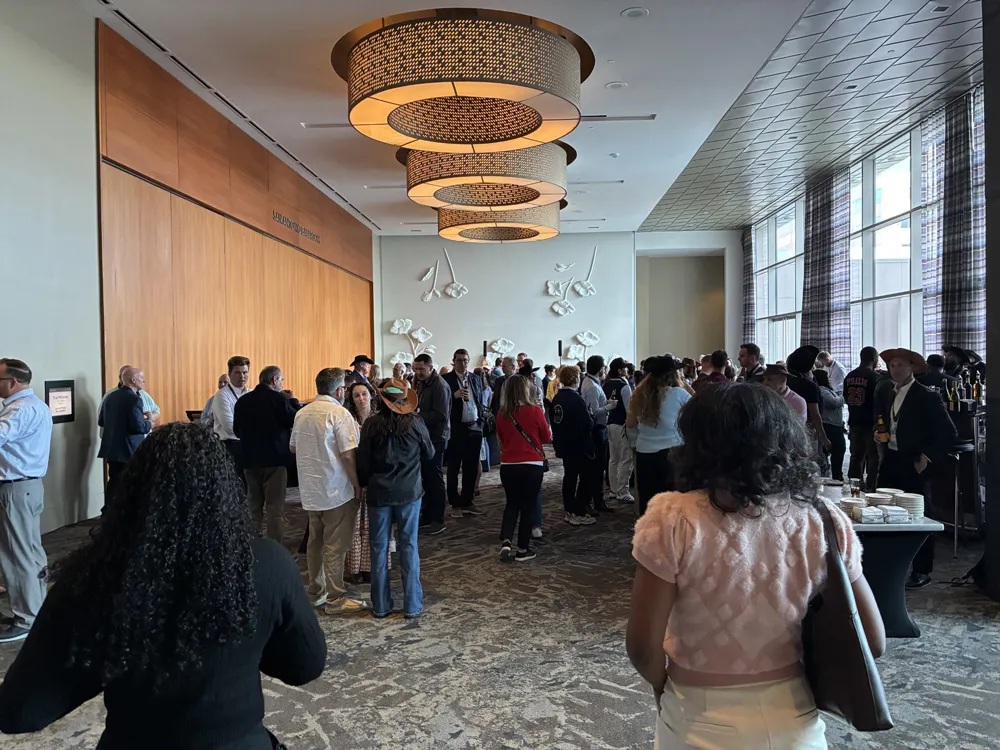
Something happened in Dallas last week that doesn’t show up in any session recording or slide deck. It happened in hallway conversations, at round tables over Texas barbecue, and in the quiet moment when a room full of local government leaders collectively exhaled.
“We are not alone in the struggles,” said Kim Bradford, an advisory board member from Goodyear, Arizona, during the conference’s closing session. “There’s something almost cathartic about having organic conversations with people at your table or in passing—‘Oh yes, this is not just us.’”
That sense of shared purpose and hard-won solidarity was the undercurrent of the 2026Transforming Local Government (TLG) Conference, hosted by the Alliance for Innovation April 20–22. More than 300 local government professionals gathered for three days of sessions, workshops, and off-site innovation tours—coming away not just with notebooks full of ideas, but with something harder to quantify: renewed conviction that the work they do matters, and that doing it better is worth the effort.
A Conference Shaped by the People in the Room
The Alliance for Innovation has spent more than four decades serving those at the forefront of local government, and TLG reflects that mission in its design. This wasn’t a conference where attendees passively consumed content. Open Space Technology put participants in the driver’s seat on day two, inviting leaders to surface the topics most critical to their communities and self-organize around them. The result was focused, peer-driven dialogue that no pre-set agenda could have produced.
Glenda Blackmon-Johnson of Dallas County captured the spirit of it in her closing remarks: “You’ve created a safe space and a safe place for us to come, and you’ve engaged with us and helped us look into our own humanity—about what we do as servants to the community, how we engage with one another, and how we plan to move forward to make the difference we want to have happen.”
That orientation—toward reflection, toward honest dialogue, toward looking ahead—was woven throughout the conference’s programming.
Thinking Differently About the Future
If there was a unifying thread across sessions, it was this: the pace of change has outrun the way most local governments are equipped to respond to it.
The pre-conference workshop on Anticipatory Leadership introduced participants to strategic foresight—a discipline the United Nations has named a core competency for public sector leaders. Presenters Hauson Le and Steven Kenney walked participants through the Three Horizons Framework, Causal Layered Analysis, scenario planning, and back casting. These aren’t abstract academic tools. They’re structured methods for helping decision-makers navigate uncertainty with intention rather than just reaction.
“Foresight thinking and tools are powerful for local government,” wrote one attendee in the conference’s closing reflection exercise. Another described foresight as something that “started out very abstract and complex” but has become “very tangible and applicable” with repeated exposure.
The Tuesday afternoon participatory foresight workshop explored how communities themselves can be brought into long-term visioning—shifting ownership of the future from governments alone to society at large.
The Work on the Ground
Some of the most compelling sessions were straightforward case studies from cities doing things that are actually working.
The City of Fort Worth’s FWLab presented machine learning models that forecast building permit volumes and valuations with 96% accuracy for residential permits and 88%for commercial—turning a reactive development services function into a proactive planning and staffing tool. The City of Denver’s Peak Academy, now 13years in, has generated more than $80 million in city savings through continuous improvement training that has reached thousands of employees. Communities from Elk Grove, Calif., to Bend, Ore., to Johnson County, Kansas, shared their own innovation academy models, demonstrating that building an organizational culture of improvement is not the exclusive domain of large, well-resourced governments.
The City of Wylie, Texas, offered a full-circle story: a program born from a TLG session three years ago had grown into Ride Awake Wylie, a functioning on-demand transit program that delivered measurable outcomes in cost, accessibility, and resident satisfaction. It was a living argument for what the Alliance has always believed—that conference ideas can and do translate into community impact.
Matt Mueller, City Manager of Little Elm, Texas, came to the conference with a newly formed innovation group and left with a clearer sense of how to grow it.
“My biggest takeaway was hearing some of the stories from Denver and Olathe,” he said at the closing session. “We can work with our team on how to take (those ideas) and grow them. Because where we want to get is to be more forward-thinking and have a good process to address all of the new opportunities that are coming our way.”
Navigating AI—Together
Artificial intelligence was everywhere at TLG 2026, not as hype, but as a genuine operational question that local governments are scrambling to answer. Dustin Haisler’s session on responsible AI governance delivered an eye-opening assessment: 75% of government agencies are already using AI, but only 14% have sufficient governance in place. Nearly 60% of AI utilization in the public sector is unapproved.
Attendees walked away with a practical frame: governance isn’t the brake on innovation, it’s the accelerator. The challenge isn’t whether AI will change government—it will—but whether government will be ready.
“Govern your AI use before it gets out of hand,” wrote one attendee in the closing reflection. Others noted the urgency of the human element: “Invest time in AI” appeared alongside “Human component is more important than ever”—a tension the conference held honestly rather than papering over.
What People Are Taking Home
The closing reflection drew responses from 59 attendees, and the picture they painted was striking in its consistency. The same themes surfaced again and again, expressed in different words:
· You are not alone. “We are all dealing with some of the same issues. It was validating and a bit comforting to know that we aren’t alone; just all in a different phase of improvement.”
· The people in the room matter as much as the content. “Found my tribe.” “New friends and great conversation.” “These are my people.”
· Ideas are only the beginning. “Progress does not require perfection.” “Start small, it will grow over time. Simply start.” “Don’t wait until life’s perfect to act.”
· In-person is irreplaceable. “There’s no substitute for in-person learning and networking. Online is great, but nothing beats face to face.” “The importance of being in person in AI times.”
Heidi Behrends Cerniwey, City Manager of Ellensburg, Washington, and a first-time TLG attendee who joined the AFI board this year, said she walked away with are reinforced conviction about the power of storytelling and metaphor in communicating change—and with a deeper sense of responsibility to keep the learning going.
“As a new board member, I’m really interested in learning how we can take what we do hereto learn from one another and support one another throughout the rest of the year,” she said. “So, it’s not just a one-time experience.”
That’s exactly the point. The Alliance for Innovation builds innovation capacity—the capacity to anticipate change, respond to emerging challenges, and deliver meaningful improvements for communities. TLG is one node in that network. The Member Meetups and Regional Meetings hosted by the Alliance create opportunities for local government leaders to connect in smaller, more personal settings where meaningful dialogue and practical collaboration can happen. Because they are place-based and practitioner-focused, these gatherings strengthen relationships across jurisdictions and roles—helping members share experiences, surface emerging issues, and highlight innovations happening inn ear by communities. The conversations that started in Dallas will continue there, and in the daily work of the professionals who came.
Note: This is the first in a series of articles drawn from the 2026 TLG Conference. In the coming weeks and months, we'll take a deeper look at the ideas and innovations that generated the most conversation in Dallas—starting with a closer look at strategic foresight and participatory foresight, two disciplines that are quietly reshaping how local governments think about the future.
Denise Christensen from Louisiana, Minnesota, summed up her three days with characteristic wit: “I have never felt more excited and happy to be called a loser in my life.”
She was referring to a frame from keynote speaker Nick Kittle, who drew a distinction between bronze medalists—happy just to be on the podium—and silver medalists, who know exactly what it takes to reach the top and are hungry to close the gap. In Kittle’s telling, the “loser” is not a consolation prize. It’s a starting point. That turned out to be one of the more apt metaphors of the week: most of the leaders in the room know exactly what better looks like. They came to Dallas to figure out how to get there.
See you next year in Kansas City!

Sign up to gain access to our network of innovators to receive updates on emerging trends and AFI research. Stay informed on the forces shaping local government. new snippet of text