When Residents Know What Their Government Is Doing, They Trust It.
New findings from three independent research teams converge on what actually moves the needle—and why it starts with governance, not communications. Trust in local government is falling—and practitioners have felt it long before researchers began measuring it. Disinformation spreads faster than it can be corrected. Residents arrive at public meetings with conclusions already formed. National political currents contaminate local conversations in ways that bear no relationship to how well a city is actually managing its services.
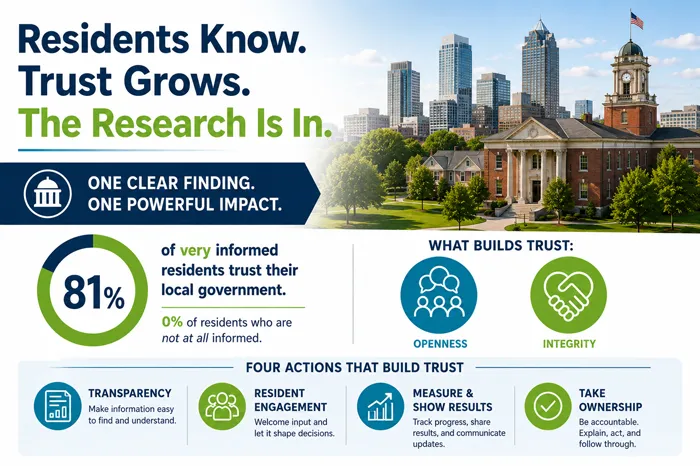
What local government leaders may not know is that researchers have spent several years studying what actually builds trust—not what feels right, not conventional wisdom, but what the data shows. At the 2026 Transforming Local Government Conference in Dallas, three independent organizations presented findings that converged on the same answer.
The convergence was notable. Elizabeth Steward, VP of marketing and research at Envisio, partnered with Arizona State University, the National League of Cities, and survey firm Polco to study trust across three diverse communities—a suburb of Columbus, Ohio; a suburb of Chicago; and a large city in the Los Angeles area. Their goal: identify where trust breaks down and develop empirically grounded steps to strengthen it. Chris Morrill, executive director of the Government Finance Officers Association, shared GFOA's framework for rethinking public engagement, built on years of working with finance officers navigating fiscal transparency and community resistance. David Swindell of Indiana University's Public Policy Institute brought fresh survey data collected in Indianapolis just weeks before the conference.
Three organizations. Three methodologies. The same answer.
The Four Indicators—and the Two That Drive Everything
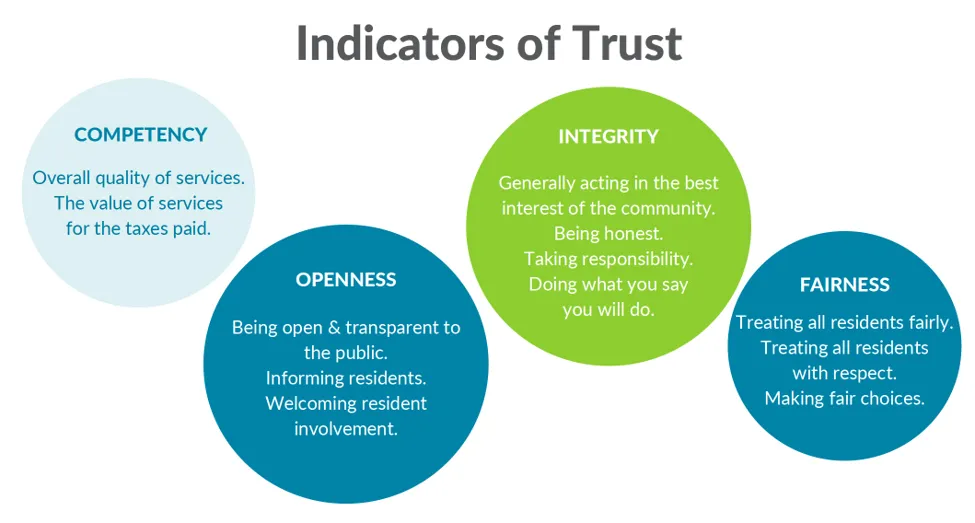
The research identified four indicators of trust in local government: competency, openness, integrity, and fairness. Competency means residents believe they are receiving quality services worth what they pay. Fairness means decisions are made equitably, in ways people can respect even when they disagree. Openness means the government is transparent proactively informs residents, and welcomes their involvement. Integrity means acting in the community's best interest, being honest, taking responsibility, and following through on commitments.
Those four indicators describe what trust looks like. The researchers then asked what actually drives it — what moves residents from skeptical to believing. Two factors rose above the others: openness and integrity. Not service quality. Not communications volume. The behaviors that built trust were informing residents, acting in the community's best interest, and taking responsibility when things go wrong.
Those are governance behaviors first. Communications is the means by which they are demonstrated.
The Data Point That Changes the Conversation
The researchers then measured something deceptively simple: how informed residents felt about their local government's activities, events, and services. Four levels — not at all informed, slightly informed, somewhat informed, and very informed. They then tracked trust and confidence at each level.
The result:
Residents who described themselves as very informed showed roughly 80 percent confidence in their local government and81 percent trust that it would do the right thing.
Residents who described themselves as not at all informed: zero. On both measures.
Not low. Zero.
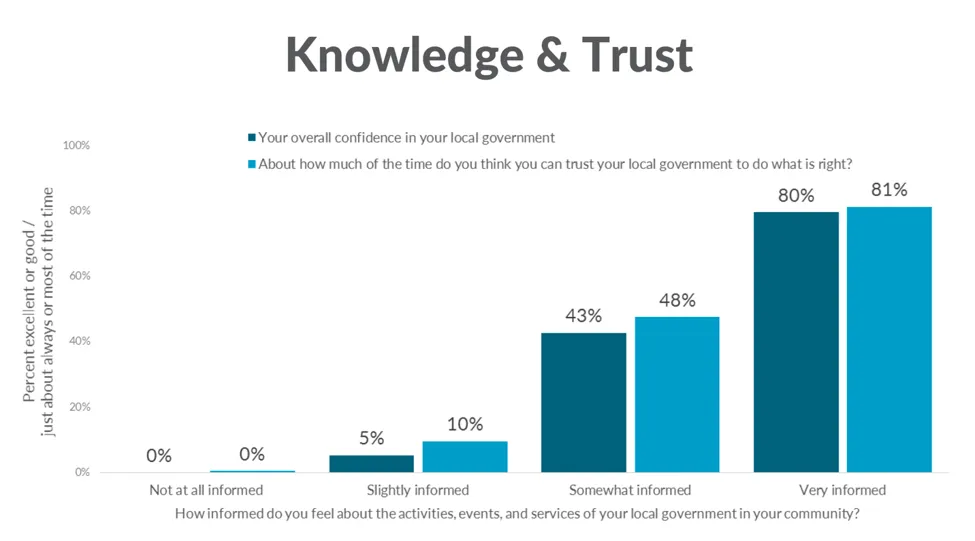
This is not a marginal effect. It is a categorical one. Residents who know what their government is doing, why it is doing it, and what it costs are dramatically more likely to trust it. The organizations that understand this do not treat communication as an outreach function. They treat it as a core governance responsibility — as essential as the services themselves.
Four Takeaways Practitioners Can Apply Now
Steward laid out four research-supported actions that local government leaders can apply immediately.
Transparency matters—but only if resident scan find it and understand it. Posting a budget online is not enough. Residents will not go looking. The information has to come to them.
Communicate actively and consistently. Transparency only builds trust when residents encounter it. Data always requires storytelling and context. Numbers without narrative do not build trust—they create confusion.
Measure progress, show results, and take ownership. Accountability is not simply accepting blame. It means explaining what went wrong, naming corrective steps, communicating updates on those steps, and building an organizational culture in which accountability is the expectation rather than the exception.
Welcome resident participation. When residents have real avenues to engage—and when their input visibly shapes decisions—trust follows. The City of Dublin, Ohio, one of the three communities in the Envisio study, runs trust levels around 70 percent, well above national benchmarks. Dublin got there through multi-channel engagement including surveys, mobile apps, social media, and traditional outreach; proactive communication that incorporates sentiment analysis; and survey responses that have fed directly into policy decisions, including renewable energy.
Quality Over Quantity: The GFOA Caution
The GFOA framework adds a dimension that deserves particular attention. Morrill's team makes a point that more local government leaders need to hear: low-quality engagement can actually harm trust.
Showing up to listen when the decision isalready made, running a public meeting that generates heat but no light, engaging on issues where resident input cannot meaningfully influencedirection—these do not merely waste time. They erode the credibility needed forthe moments when engagement matters most. The discipline is knowing when toengage, designing it for quality over quantity, and giving residents genuinetradeoffs to work through rather than a comment form to complete after thefact.
The Takeaway for Local Government Leaders
Local government practitioners cannot control what is happening at the national or state level. They cannot neutralize bad-faith actors or manage what gets amplified in social media comment sections. What they can control is the quality of governance and communication within their own organizations.
The research confirms what the most effective local government leaders have long understood: trust is not a crisis communications problem, a rebrand, or a content calendar. It is the accumulation of years of doing the right thing, engaging the public honestly, and treating communication not as a supplementary activity but as a core function of governance.
The data does not make that work easier. What it does is confirm that the work accumulates—and that it matters.

Sign up to gain access to our network of innovators to receive updates on emerging trends and AFI research. Stay informed on the forces shaping local government. new snippet of text