Turning Questions into Solutions: How Comparative Research Helps Local Governments Make Progress
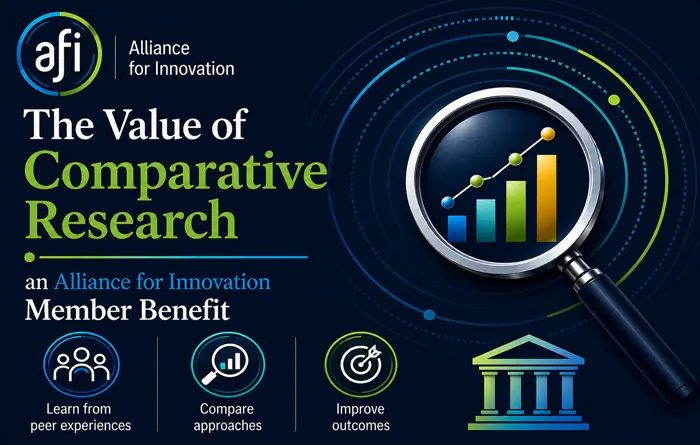
The Alliance for Innovation's Comparative Research Service is designed to help local governments gain access to peer-reviewed research, best practices, and real-world examples from communities across the country. As part of AFI’s membership benefits, organizations receive a custom comparative research or best practice study annually, providing timely insights that support informed decision-making and organizational learning.
Local government leaders face increasingly complex challenges. Whether addressing workforce shortages, evaluating emerging technologies, redesigning service delivery models, or exploring innovative policy approaches, organizations are often confronted with the same question:
Has another community already solved this problem?
Finding those answers can be time-consuming. Staff must sift through reports, search for peer examples, evaluate best practices, and determine what lessons are truly applicable to their community. The process can consume valuable resources that many local governments simply do not have.
That is where comparative research becomes a powerful tool.
The Alliance for Innovation's Comparative Research Service is designed to help local governments gain access to peer-reviewed research, best practices, and real-world examples from communities across the country. As part of AFI’s membership benefits, organizations receive a custom comparative research or best practice study annually, providing timely insights that support informed decision-making and organizational learning. Studies are typically completed within two weeks, giving leaders rapid access to actionable information when they need it most.
Learning from the Experiences of Others
One of the greatest strengths of local government is the willingness of communities to share ideas and learn from one another. Comparative research leverages this collaborative spirit by identifying how peer organizations are approaching similar challenges.
Rather than starting from scratch, leaders can review proven practices, understand implementation considerations, and evaluate outcomes achieved elsewhere. This approach helps reduce risk, accelerate innovation, and allows organizations to make more informed decisions based on evidence rather than assumptions.
From organizational structure and performance management to artificial intelligence, resident engagement, workforce development, and strategic planning, comparative research provides valuable context that helps communities adapt successful practices to their own unique circumstances.
Beyond Benchmarking
While benchmarking remains an important component of organizational improvement, comparative research goes a step further.
The goal is not simply to identify what other communities are doing, but to understand why certain approaches work, what challenges emerged during implementation, and what lessons can be applied locally. This deeper analysis helps organizations move beyond metrics and toward meaningful organizational learning.
By examining multiple peer communities and synthesizing findings into practical recommendations, comparative research becomes a strategic resource for managers, department directors, elected officials, and project teams alike.
Building Organizational Capacity
A significant advantage of the Alliance's approach is that completed studies are made available to staff throughout member organizations through the Alliance Member Circle knowledge-sharing platform. This allows organizations to build institutional knowledge, support professional development, and encourage continuous learning across departments.
When research is shared broadly, organizations create opportunities for innovation to emerge from every level of the organization. Employees gain access to ideas and practices they may not have otherwise encountered, helping foster a culture of curiosity and improvement.
Supporting Better Decisions
In an environment where local governments are expected to do more with limited resources, access to reliable information has never been more important.
Comparative research helps leaders make decisions with greater confidence by providing objective analysis, peer examples, and evidence-based practices. It transforms questions into opportunities for learning and creates a bridge between innovation and implementation.
Most importantly, it reminds us that local governments do not have to solve challenges alone. Across the country, communities are experimenting, adapting, and innovating every day. Comparative research allows those lessons to be shared, helping all communities move forward together.
As local governments continue to navigate rapid change, comparative research will remain an essential tool for identifying opportunities, reducing uncertainty, and delivering better outcomes for the residents they serve.
To request your research study here or contact Tracy Miller, Vice President of Member Experience at tracymiller@transformgov.org.

Sign up to gain access to our network of innovators to receive updates on emerging trends and AFI research. Stay informed on the forces shaping local government. new snippet of text