Data Centers: What Does the Public Think?
At the recent Florida City and County Management Annual Conference I had the privilege to participate on a panel with Scott Butler City Manager from Mesa, AZ, and Jonathan Lewis, County Administrator from Sarasota County on what has become a volatile land-use question related to the construction of Data Centers in our communities. Our presentation centered on findings from a recent report published by Zencity entitled, “Data Centers National Survey Report: For Local Government Leaders Navigating the Data Center Debate,” as well as real-life insights from Mesa, AZ who is currently permitted 16 data centers, and Sarasota County which currently evaluating their land use development code on the construction of data centers.
By Lee R. Feldman, ICMA-CM RETIRED, Senior Advisor, Zencity
According to Mayor David Holt of Oklahoma City "If you had asked me about data centers five months ago, I would have said, 'What's a data center?' Now it's everywhere. That's a short amount of time for people to fully form an opinion."
In five months, we have gone from "what's a data center" to the single most explosive land-use question in American local government. If you are a city manager or a county administrator, I do not need to tell you this, you are living it.
In just the last few months in the State of Florida:
• DeSoto County approved an AI data center near Arcadia.
• Okeechobee County scrapped one after three thousand residents signed a petition.
• Project Tango in Palm Beach County drew over eight thousand opposition signatures and forced a unanimous Wellington Village Council resolution.
• Nassau County is advancing a twelve-month moratorium.
• Fort Meade approved a 4.4 million square foot facility and got publicly questioned by the state Secretary of Commerce. And the Governor just signed a statewide bill regulating these projects.
This issue has come at us faster than any infrastructure debate I can remember.
Why Data Centers Became Controversial
So what are the key questions we should address:
1. Why did this become so controversial, so fast?
2. Have we actually seen this kind of fight before?
3. What does the actual data tell us about what residents are thinking?
On the first question, there are really four forces converging at the same time.
One: scale. These are not the data centers of 2015. A single hyperscale AI campus can occupy thousands of acres, draw hundreds of megawatts, and consume more water in a day than a small town uses in a month. The footprint has outgrown the regulatory frameworks we wrote for it.
Two: speed. Tech developers move on quarterly timelines. Local government moves on comp-plan timelines. When a developer wants a site rezoned in ninety days and your community plan was last updated in the 1990s, friction is inevitable.
Three: secrecy. NDAs, code names, shell LLCs. Residents read about "Project Tango" or "Project Jarvis" in the newspaper before their elected officials can even confirm who the end user is. In a high-trust environment that might be tolerable. We are not in a high-trust environment.
Four: AI itself. Data centers are no longer perceived as neutral utility infrastructure. They are the physical backbone of artificial intelligence, and AI is now a contested cultural and political issue. When residents oppose a data center, they are often expressing something larger about technology, about jobs, about the pace of change.
Put those four forces together, and you have what we are seeing nationally: ballot measures, recall efforts, council meetings running until midnight, and state legislatures stepping in because they don't trust local governments to get it right.
We've Been Here Before: The Automobile
Now if all of that feels unprecedented — like local government has never faced a technology this disruptive, this fast — I want to push back on that for a second. Because we have been here before. And the parallel is closer than you might think.
Roll the clock back to about 1900 when the automobile arrives. Reaction in American cities looks remarkably like what we are seeing today.
Streets at the turn of the twentieth century were not for cars. They were public space, shared by pedestrians, cyclists, streetcars, vendor carts, and children playing. When the first horseless carriages started tearing through neighborhoods, residents responded the way residents always respond when something disruptive arrives faster than the rules governing it. They threw stones. They shot at cars. They strung wires between trees to stop them. Rural communities dug ditches across roads. Newspapers called drivers "killers" and "remorseless murderers." In 1921, in Pittsburgh alone, 286 children were killed by automobiles. Cities held memorial marches and rang church bells for traffic deaths.
And local governments responded the way local governments always respond. They tried to legislate. Cincinnati put a measure on the ballot in the early 1920s that would have required every automobile in the city to be fitted with a governor, a mechanical device limiting speed to 25 miles per hour. The auto industry mobilized, defeated the measure, and panicked enough about what came next that they launched a national campaign to redefine the street itself. That campaign gave us a word that did not exist before: jaywalking. The first person ever arrested for it was in Kansas City, in 1912.
I want you to hold that picture next to what is happening today. A new technology arrives at scale. It is genuinely transformative, and genuinely disruptive. It outpaces the regulatory frameworks that exist. Residents organize. Ballot measures are filed. Local governments scramble to write rules. The industry pushes back. State and federal authorities eventually step in to set a framework. And the whole thing takes, depending on how you count it, between thirty and fifty years to fully settle.
The differences matter, of course. Cars killed thousands of children. Data centers do not. Cars reshaped the physical form of every American city for a century. Data centers will not. But the governance pattern, the speed of arrival, the gap between the technology and the rules, the visible early opposition, the role of local officials caught between residents and industry, that pattern is almost identical.
Why does this matter for to local government professionals? Two reasons.
• First, it should give us some humility about the moment. The right answer was not obvious in 1910, and it is not obvious in 2026. Communities that moved first sometimes got it wrong. Cincinnati's governor ordinance failed; Los Angeles's 1925 traffic code arguably gave away too much. Communities that waited sometimes got it right by letting better information accumulate. There is no clean playbook.
• Second, it should give us some confidence. Local government did eventually figure out how to govern the automobile. We built zoning codes, traffic engineering, environmental review, parking standards, safety regulation, an entire apparatus that did not exist in 1900. We will figure this one out too. The question is whether we figure it out in five years or fifty, and how many bad decisions we make along the way.
What the Data Actually Says
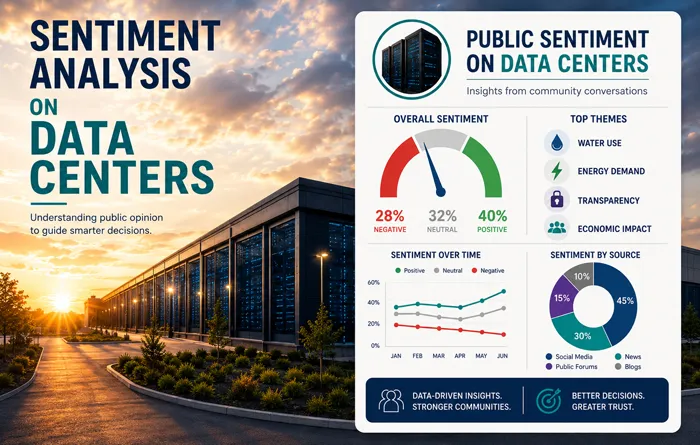
Which brings me to the third question, what does the actual data tell us about what residents are thinking right now? Zencity conducted a sentiment survey of roughly nineteen hundred Americans in April on the issue and this is what we found.
Finding number one: the country is genuinely split, and one in three Americans is undecided. Thirty-five percent of Americans support building more data centers. Thirty percent oppose. And thirty-three percent, one in three, neither support nor oppose.
Now I want you to sit with that last number for a second. One in three. That is the most important statistic in this entire report, and I'll tell you why. The loud voices in your council chambers, the people who show up at every zoning hearing, who post on Facebook, who organize the petition drive, those people are not a third of your community. They might be three percent. But they are visible, and they are vocal, and they fill the room. The other ninety-seven percent of your community is not in the room. And a third of them, statistically, haven't made up their minds.
What does this means practically: if you are making policy based only on the people who turned out to last Tuesday's hearing, you are governing for the loudest fraction of your community and ignoring the largest one. The persuadable middle is real. It is bigger than either the support camp or the opposition camp. And it is invisible unless you go looking for it.
Finding number two: support collapses when projects move close to home. Nationally, support for data centers in general beats opposition 35 to 30. But when you ask residents about a data center in their own community, the numbers flip — 39 percent oppose, 35 percent support, only 26 percent neutral.
This is the NIMBY effect, and it is bigger here than it is for most infrastructure. Residents support the digital economy in the abstract, they use the cloud, they stream Netflix, they ask Alexa what the weather is. But the moment that infrastructure moves next to their neighborhood, their tolerance drops fast. Additionally, the neutrals shrink too, from 33 percent down to 26 percent, because proximity forces people to pick a side. The case you make at a regional economic development summit is not the case you can make at a community meeting in the affected neighborhood. They are two different conversations.
Finding number three: this is a water and electricity story, not a jobs story. Eighty-six percent of residents say water impact is important to them. Eighty-five percent say electricity rates. Compare that to 65 percent for job creation and 61 percent for tax revenue.
That is a twenty-point gap between what residents are actually worried about and what economic development decks usually lead with. The concern intensifies with the demographics most likely to vote, among residents over 55, 92 percent rate water as important and among college-educated residents, 93 percent.
When you walk into a community meeting with a presentation full of jobs numbers and tax projections, you are answering a question your residents are not asking. They want to know whether their water bill is going up. They want to know whether the grid will hold during a heat wave. They want to know whether their well will run dry during the next drought. If those questions are not the first three things out of your mouth, you have already lost the room.
Finding number four: opposition has a demographic profile, and it overlaps almost perfectly with your voter file. Residents over 55, college-educated, and white are the most opposed. Forty-six percent opposition among the 55-plus cohort. Fifty-one percent opposition among residents with a higher-education degree.
Those are also the residents most likely to vote in your municipal elections, most likely to attend your zoning hearings, and most likely to write op-eds in the local paper. So when you read in the news that opposition is mounting in a community, what you are often seeing is not majority sentiment, it is the most politically active segment of the community expressing concerns the rest of the community shares but expresses less loudly. The concern is real. But the volume can be misleading.
Finding number five — and this is the one that stopped me cold: only 22 percent of residents trust local government officials to give them accurate information about data center impacts. Independent environmental organizations? Fifty-seven percent. State regulators? Thirty-one percent. Even local news media beats us at 23 percent.
Local officials are trusted less on this issue than the local newspaper. We are barely more trusted than the data center company itself, which sits at 14 percent. That is a sobering moment for our profession, and it has a direct strategic consequence. It means the answer cannot be a city-led PR campaign. It cannot be a glossy brochure with the city seal on it. The answer has to be third-party validation, independent environmental review, transparent data made public early, real partnership with credible outside voices that residents already trust. If you try to be the messenger on this, the message will not land. If you bring in the right outside validators, the same facts will.
Finding number six: half of Americans want to make this decision themselves. Fifty percent of residents say the final decision on a data center should be made by public vote. Only 21 percent say public comment with elected officials deciding. Only 9 percent, say city or county staff should decide.
That is a very hard number for local government professionals to accept. We pride ourselves on being the technical experts who, on every other complex land-use decision, are expected to weigh the evidence and make a recommendation. On this one, 91 percent of Americans according to this study say that's not enough, they want a more direct voice. That is a structural challenge to how we normally operate, and we have to take it seriously.
Finding number seven: AI familiarity is the single strongest predictor of support. Sixty-three percent of people who feel positively about AI support local data centers. Among AI skeptics, that number drops to 17 percent, a 46-point gap. Among daily AI users, support is three times higher than among people who never use AI tools.
The data center debate is inseparable from the broader AI debate. You cannot win the local fight if you ignore that context. The most persuadable residents are the ones who already use these tools and see the value. The hardest residents to move are the ones who view AI itself as a threat, and no amount of jobs and tax revenue argument will reach them, because the project is a proxy for something larger.
You can read Zencity’s report: “Data Centers National Survey Report: For Local Government Leaders Navigating the Data Center Debate” in it’s entirety in the Alliance for Innovation Member Circle. Link here to join.


Sign up to gain access to our network of innovators to receive updates on emerging trends and AFI research. Stay informed on the forces shaping local government. new snippet of text