From Measurement to Performance Excellence: Building Local Governments That Learn, Adapt and Improve
The real value of performance management comes when organizations connect strategy to measurement in a system that promotes leadership and employee accountability, meeting customer expectation and continuous improvement. This kind of high performance environment helps leadership understand what is working, identify where change is needed, and make better decisions.
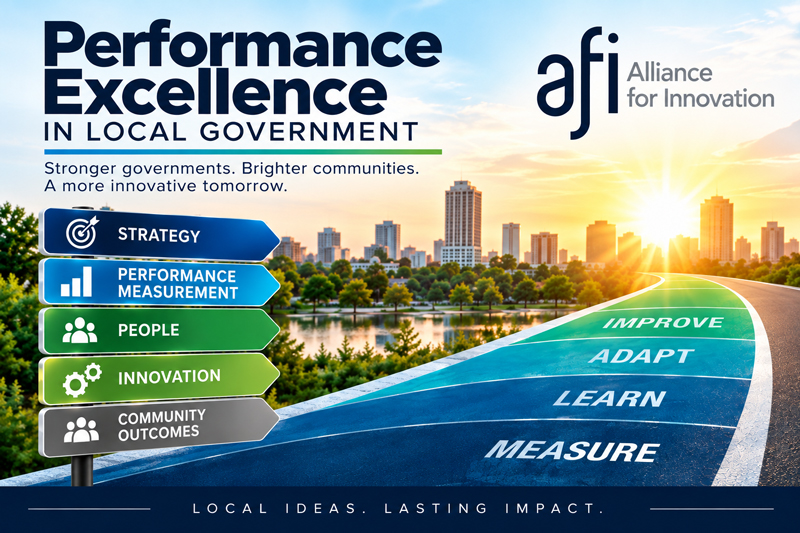
Local governments collect enormous amounts of data. But collecting data is not the same as using it effectively. The real value of performance management comes when organizations connect strategy to measurement in a system that promotes leadership and employee accountability, meeting customer expectation and continuous improvement. This kind of high performance environment helps leadership understand what is working, identify where change is needed, and make better decisions.
Throughout our history the Alliance has worked with local governments to strengthen organizations, foster innovation, and improve outcomes for the communities they serve. Central to that work is a belief that innovation and organizational improvement are not the responsibility of one department or individual, they become sustainable when they are embedded throughout the culture and operating practices of the organization. Performance management is an important part of building that capacity.
Effective performance management goes far beyond collecting measures or producing dashboards. It connects strategic priorities, performance information, leadership decision-making, resource allocation, and improvement efforts into an ongoing cycle of learning and refinement.
That is why the Alliance is expanding its work aroundperformance excellence with new tools, practical training, peer case studies,and opportunities for local governments to learn from one another.
Two upcoming Alliance Member Circle webinars begin that conversation: Understanding the Alliance Performance Management Spectrum Model on September 15 and Building an Innovation Mindset Through Performance Excellence on October 20. Together, they explore an important idea:
Performance management should not simply tell an organization what happened. It should help the organization decide what to do next.
A Roadmap for Performance Excellence
The foundation of this effort is the Alliance Performance Management Spectrum, a practical framework designed to help local governments understand where they are today and identify a path toward greater organizational performance.
The Spectrum recognizes that organizations are at different stages of their performance journey. Rather than prescribing a single model, it identifies four levels of maturity including: Basic Performance Management, Intermediate Performance Management, Advanced Performance Management, and Performance Management Excellence. These levels are then assessed across six interconnected categories including:
· Data Collection
· Leadership & Accountability
· Strategic Plan Alignment
· Customer Engagement
· Employee Involvement
· Practice Adoption & Comparison
The framework was developed through research and adaptation of leading approaches, including the former ICMA Performance Management Certificate Program, the Baldrige Performance Excellence Program, Florida Sterling performance excellence criteria, and the PerformanceStat model.
The important word is Spectrum.
Organizations do not suddenly become high-performing becausethey purchase dashboard software or establish a set of key performanceindicators. Performance excellence develops over time as practices become moresophisticated and increasingly integrated into how the organization operates.
A government might begin by tracking how many permits it processes or calls for service it receives. Over time, it can progress toward measuring efficiency, effectiveness, process performance, and ultimately community outcomes. The same evolution occurs in leadership, strategy, customer engagement, and employee involvement.
The goal is not simply more measures. The goal is a better organization.
Performance Management and Innovation Belong Together
Performance management is sometimes viewed as being about control and accountability, while innovation is associated with experimentation and change. In reality, the two should reinforce one another. Innovation ask an organization to try something different. Performance management helps the organization determine whether that different approach actually worked.
A mature performance environment creates what the Alliance describes as an act, learn, adapt loop. Organizations identify performance gaps, establish targets, develop strategies, evaluate results, and adjust their approach based on what they learn.
That creates an environment where experimentation can become more intentional. Instead of innovating because an idea sounds promising, organizations can identify where performance indicates change is needed, test new approaches, measure the results, learn from failure, and expand approaches that demonstrate value.
At the highest level, performance excellence becomes a continuous cycle in which strategy informs measurement, measurement informs decisions, decisions lead to action, and results generate new learning. That is an innovation system that values performance management.
Learning from Communities Doing the Work
Frameworks become more valuable when local governments can see how the ideas work in practice. That is why peer learning and case studies will be an important part of the Alliance's performance excellence work.
The September 15 Spectrum webinar will feature Fort Lauderdale, Florida, and Goodyear, Arizona, providing two perspectives on how performance management has become part of organizational decision-making and culture. The October 20 webinar will feature Gilbert, Arizona and Little Elm, Texas. Together, Gilbert and Little Elm demonstrate two complementary approaches to building performance capacity. Gilbert shows how to strengthen the infrastructure, ownership, tools, and organizational capabilities surrounding performance management while Little Elm shows how to connect Council priorities to departmental plans, measures, targets, resources, and results.
Fort Lauderdale: Connecting Performance, Strategy andResources
The City of Fort Lauderdale demonstrates the importance of integrating performance management with broader organizational systems. The City's performance program connects performance management closely with its Strategic Plan and annual budget, helping leaders understand where resources can have the greatest impact and where continued improvement may be necessary.
That connection represents an important step in performance maturity. A performance measure becomes considerably more powerful when it is not viewed in isolation but connected to a strategic priority, discussed by leadership, and ultimately considered when decisions about people, programs, and resources are made.
The Alliance Spectrum reflects that progression. At higher levels of performance maturity, leaders move beyond reviewing data to identifying performance deficits, developing strategies, allocating resources, and creating continuous organizational learning.
Goodyear: Making Performance Part of the Culture
The City of Goodyear, Arizona, offers another perspective, performance management as part of an organization's broader innovation culture. During the Spectrum webinar, Goodyear leaders will explore both the organizational approach to performance management and how those principles translate into the practical work of the City's Development Services Department.
That department-level perspective is particularly valuable because performance excellence ultimately has to move beyond an organizational dashboard. It has to influence everyday work.
Employees need to understand what is being measured, why it matters, how their work contributes to organizational priorities, and how performance information can help them improve services. As performance maturity increases, the Alliance Spectrum calls for stronger performance teams, greater employee access to performance information, integration into onboarding and training, and ultimately stronger connections between employee and organizational performance.
Gilbert: Modernizing Performance Management AroundService and Results
The Town of Gilbert, Arizona, which will join the panel for the Alliance's Building an Innovation Mindset Through Performance Excellence webinar, provides another example of how performance management can evolve from collecting measures into a broader organizational approach to improving services and results.
As Gilbert grew, the Town faced a challenge familiar to many local governments. Departments were collecting data, but measures varied in quality, ownership, and relevance, and leadership lacked a consistent way to determine whether services were achieving desired outcomes or advancing strategic priorities. Gilbert responded with a multi-phase Performance Management Modernization initiative designed to align services, performance measures, strategic priorities, and community outcomes.
A particularly important part of Gilbert's approach has been taking performance management into the organization rather than keeping it within a central office. Department Data Strategists provide analytical support directly within departments, helping employees use performance information in their daily work. A cross-functional Core Performance Team provides coaching, onboarding, peer review, and continuous-improvement support across the organization.
Gilbert has also worked to create a shared language around performance. Through workshops, coaching, and peer reviews, the Town surfaced more than 250 Lines of Service as a working inventory of how the organization delivers value. Evaluation tools help departments examine whether their measures are meaningful, connected to community needs, and capable of demonstrating results, helping shift the conversation from simply tracking activity toward understanding impact.
But perhaps the most important result is not the number of dashboards or measures. It is that performance analysis is becoming routine in daily operations. Departments are increasingly combining data, visuals, narrative, and outcome-focused reporting to explain not simply what government is doing, but the impact those services are producing.
Gilbert's experience reinforces a central message of the Alliance's approach to performance excellence: the objective is not to collect more data. It is to build an organization capable of using data to learn, make decisions, improve services, and adapt.
Little Elm, Texas: Creating a Culture of Evidence
The Town of Little Elm, Texas, brings another important dimension to the October panel by demonstrating how performance management can connect the priorities of elected officials with the everyday work of departments. Little Elm's Performance Management Program is designed to embed performance management into the heart of the organization and create a strong culture of evidence. The Town translates its Town Council Strategic Plan into measurable action through department-specific strategic plans, aligning departmental workplans with the Town's broader focus areas and objectives.
The Alliance Performance Management Spectrum identifies strategic alignment as a progression, from simply discussing measurement during strategic planning, to aligning department measures with the strategic plan, tracking major initiatives, and ultimately using qualitative goals and objectives throughout the organization. Little Elm provides a practical example of what that alignment can look like.
By establishing meaningful performance measures and targets, monitoring results, and using performance information to guide budgeting, operations, and service improvements, the Town creates a clearer line between what the Council wants to accomplish and how departments translate those priorities into action. The approach also demonstrates why performance measures should not exist simply for reporting purposes. When measures are connected to strategy and incorporated into management decisions, they can strengthen accountability, transparency, responsible stewardship, and evidence-based decision-making.
Start Where You Are. Build What Comes Next.
There is no single starting point for a performance excellence journey to begin. One organization may be developing its first set of meaningful measures. Another may be building a dashboard. Another may be trying to connect measures to its strategic plan. A more mature organization may be using performance information to allocate resources, engage residents, evaluate programs, or drive continuous process improvement.
The Alliance Performance Management Spectrum is designed to meet organizations wherever they are.
Organizations do not have to advance through every category simultaneously. Instead, they can assess their current maturity, identify where greater capability would create the most value, establish priorities, and intentionally build from there.
Because performance excellence is not achieved by producing the perfect dashboard. It is built when an organization develops the capacity to measure what matters, learn from what it discovers, make better decisions, adapt when necessary, and continuously improve the outcomes it delivers to its community.
That is also how local governments build the capacity toinnovate.
There is still time to RSVP for these Webinars. Understanding the Alliance Performance Management Spectrum Model airs on September 15 and Building an Innovation Mindset Through Performance Excellence on October 20 on the Member Circle. If you miss it you may watch on demand on The Circle. Download the Alliance Performance Management Spectrum here. The spectrum are an evolving tool for our local government members. We welcome your suggestions for improvement and adaptation. Contact Tracy Miller, Alliance for Innovation Vice President of Member Experience at tracymiller@transformgov.org.

Sign up to gain access to our network of innovators to receive updates on emerging trends and AFI research. Stay informed on the forces shaping local government. new snippet of text