What Residents Want From Your Local Government Budget: National Survey Highlights Priorities, Tradeoffs, and Expectation Gaps
Zencity’s January 2026 National Budget Report, based on a survey of 1,566 U.S. residents, provides valuable insights into community priorities, satisfaction with local government services, and expectations for public investment. The findings highlight the challenges local governments face in balancing competing priorities, particularly as residents increasingly expect budget decisions to produce tangible results.
Local government budgeting has always required difficult choices. But those choices are becoming increasingly visible to residents who are paying attention not only to what their governments fund, but whether those investments produce results they can see and experience in their daily lives.
A national survey from Zencity provides insight into how residents view local government services, where expectations are being met, and where communities may be signaling a need for greater investment. The January 2026 National Budget Report from Zencity surveyed 1,566 U.S. residents and used demographic quotas and weighting to create a broadly representative national sample.
For local government leaders preparing budgets and strategic plans, the findings reinforce an important reality: residents rarely see budgeting as a choice between services they value and services they do not. Instead, they see tradeoffs among competing priorities that often all matter.
Nearly Everything Is Important, Which Makes Prioritization Harder
One of the most significant findings is how broadly residents value municipal services. Fire and emergency medical services lead the list, with 84% of respondents rating them extremely or very important. Sanitation, public health, streets and infrastructure, police, and housing also rank highly. Even services further down the list retain meaningful levels of public support. That creates a fundamental budgeting challenge.
When nearly every service is considered important, reductions cannot simply be framed as eliminating programs residents do not value. Instead, governments are balancing one valued need against another.
This makes the connection between priorities, resources, performance, and outcomes increasingly important. Residents may understand that governments face financial constraints, but they also expect leaders to demonstrate why resources are being allocated in particular ways and what those investments are accomplishing.
Housing Emerges as the Largest Expectation Gap
Perhaps the report's strongest signal involves housing. The survey compares how important residents consider individual services with how satisfied they are with those services. Housing produces the largest gap of any service examined: 75% consider housing important, while only 45% report being satisfied, a 30-percentage-point difference.
The gap is substantially larger than those for many traditional government services. The chart below illustrates the contrast particularly clearly. Parks and recreation and libraries, arts and culture are relatively well aligned between importance and satisfaction, while housing sits at the opposite end of the spectrum.
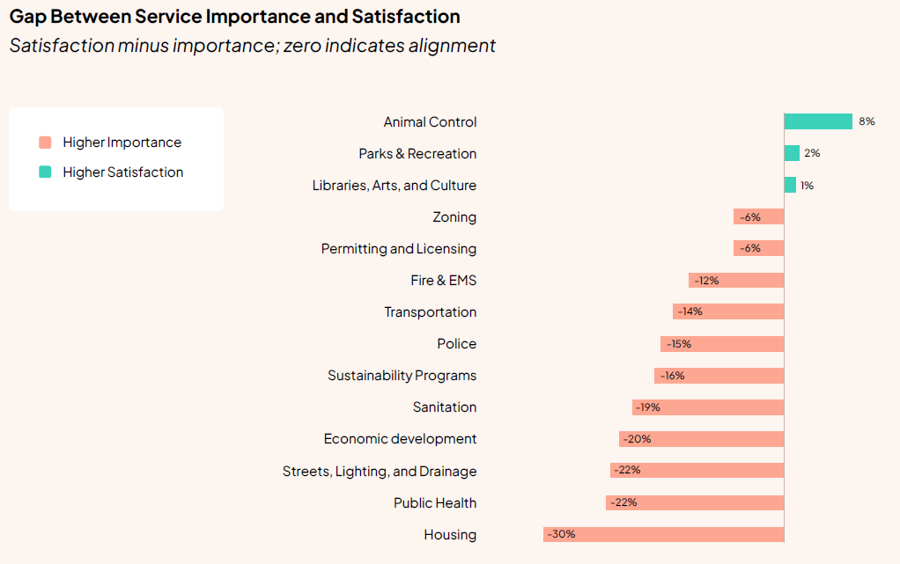
Housing also emerges when residents are asked what services or functions are missing and deserve additional investment. Housing investment received the most mentions, followed by homeless services, education, road repair, and healthcare
For local governments, this does not necessarily prescribe a particular housing policy. It does, however, suggest that housing affordability, availability, and stability are increasingly part of how residents evaluate the overall performance of their communities.
Economic Development Has an Outsized Influence on Quality of Life
Another noteworthy finding involves economic development. The report examines not simply satisfaction with individual services, but how strongly those services influence residents' perceptions of their overall quality of life. Economic development stands out as having one of the strongest relationships with quality-of-life perceptions despite relatively lower satisfaction.
Parks and recreation, police, and sanitation, by comparison, combine relatively high impact with stronger satisfaction. This distinction is important for strategic planning.
A service can receive reasonable satisfaction scores while having relatively little influence on residents' broader perceptions of their community. Conversely, another service may generate lower satisfaction while strongly affecting whether residents believe their community is thriving.
For leaders, that suggests performance management should go beyond asking, "Are residents satisfied with this service?" An equally important question is, "How much does this service affect the outcomes residents care about most?"
Residents Do Make Choices When Forced to Prioritize
Although residents generally value most municipal services, their priorities become clearer when they are forced to make tradeoffs. When asked where local governments should invest, services associated with safety and basic community stability rise toward the top. Housing and police were among the leading investment priorities, along with fire and EMS and public health.
When asked where funding could be reduced with the least impact, respondents were more likely to identify regulatory and cultural functions such as zoning, libraries, arts and culture, and permitting and licensing. The findings should not be interpreted as a universal formula for cutting or increasing particular services. Every community has different conditions, expectations, service levels, and strategic priorities. Instead, they demonstrate the value of asking residents to make choices.
Simply asking whether a service is important is unlikely to provide enough information for budget decisions because residents tend to consider most services important. Asking residents to rank priorities, identify tradeoffs, or allocate limited resources can reveal much more about what they value when choices become necessary.
Priorities Are Not Uniform Across the Community
The national findings also demonstrate why community engagement cannot treat "the public" as a single voice. Public health and sanitation consistently rank highly across demographic groups, but priorities begin to diverge beyond those shared needs. Housing rises among Black and Hispanic respondents, infrastructure is particularly important among Asian respondents, and fire and emergency medical services rank especially highly among White respondents.
Income also produces differences in priorities. That creates an important lesson for engagement: communitywide averages can hide meaningful differences in lived experience.
A budget process that relies only on the loudest participants at public meetings, or even on one overall survey result, may miss significant variations among neighborhoods and demographic groups. Effective engagement requires understanding both where consensus exists and where experiences and expectations differ.
Budget Communication Is Part of Budget Performance
The report also raises an issue that extends beyond allocation decisions themselves: trust and communication. Only 47% of respondents gave a positive assessment when asked how well their local government allocates funding to the community's most important needs. Another 25% were neutral and 29% were negative.
Confidence also varied substantially among demographic groups. Residents with higher levels of education and income reported considerably greater confidence in government funding decisions.
The implication is significant.
A technically sound budget does not automatically translate into public confidence. Residents need to understand the connection between what government is trying to accomplish, where resources are being invested, what services are being delivered, and what results those investments are producing.
That makes budget communication more than a public information function. It becomes part of the management system itself.
From Budgeting for Services to Budgeting for Outcomes
Taken together, the findings point toward a broader evolution in local government budgeting. Traditional budgets often organize resources around departments, programs, personnel, and line items. Residents, however, experience government differently. They experience well-maintained streets, responsive emergency services, attainable housing, safe neighborhoods, and a community that provides economic opportunity.
That creates an opportunity for governments to more intentionally connect through strategic planning. It is important to connect community priorities to strategic goals that are aligned with resources and services. It is then government’s responsibility to measure the performance of those priorities and determine if the community is achieving the desired outcomes.
The survey does not tell an individual city or county exactly how it should allocate its budget. Nor should national findings substitute for local engagement. Instead, the report offers something potentially more useful: a framework for asking better questions.
• Where are resident expectations exceeding current performance?
• Which services have the greatest influence on quality of life?
• Where is there broad community consensus?
• Where do experiences differ among populations?
• And when resources are limited, what tradeoffs are residents actually willing to make?
Those questions can help transform the annual budget from a financial exercise into a more meaningful conversation about community priorities, organizational performance, and the outcomes residents expect local government to deliver.
You can read Zencity’s report: “National Budget Report: Insight into Resident Priorities and Expectations” in it’s entirety in the Alliance for Innovation Member Circle. Link here to join.

Sign up to gain access to our network of innovators to receive updates on emerging trends and AFI research. Stay informed on the forces shaping local government. new snippet of text