From Comment Cards to Continuous Listening: How Olathe Built a Proactive Customer Experience Program
Over the past decade, the City of Olathe, Kansas, has transformed customer service from a largely reactive function into a proactive, data-driven approach that helps the organization understand resident experiences, anticipate needs, and make better decisions about where to focus resources.
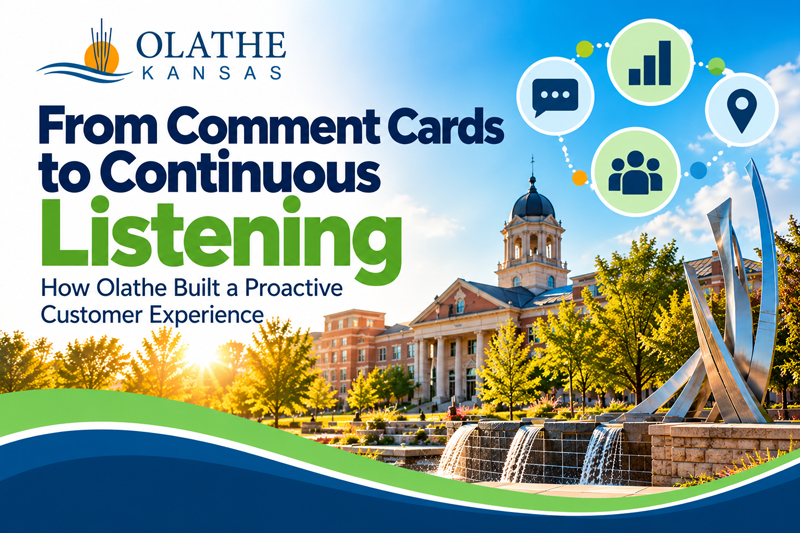
Over the past decade, the City of Olathe, Kansas, has transformed customer service from a largely reactive function into a proactive, data-driven approach that helps the organization understand resident experiences, anticipate needs, and make better decisions about where to focus resources. For many local governments, customer service traditionally begins when a resident calls, sends an email, visits a facility, or reports a problem. The organization responds, resolves the issue, and moves on.
The City of Olathe set out to build something different.
In 2016, city leadership was satisfied with Olathe’s existing customer service model but saw an opportunity to push further. The goal was ambitious: become a benchmark for local government customer experience and build a reputation for exceptional resident satisfaction. Rather than abandoning what was already working, Olathe began building on that foundation and partnering with teams across the organization that wanted deeper insight into how residents experienced their services.
Nearly a decade later, what began with comment cards and mailed surveys has evolved into a multifaceted customer experience program that combines near real-time survey feedback, operational information, digital analytics, community sentiment, and other sources of data. Instead of simply responding to individual interactions, Olathe is using those insights to understand patterns, anticipate expectations, and improve the overall resident experience.
Moving From Reactive to Proactive
One of the most significant changes in Olathe’s journey was a shift in mindset. Traditional customer service tends to be reactive: a resident has a question or problem, and government responds. Customer experience asks a broader question: What are residents experiencing throughout their interactions with the organization, and what can we learn from those experiences before problems grow?
Making that transition required Olathe to reconsider how it measured success. Many existing customer satisfaction models had been developed for private-sector businesses and did not translate easily to the realities of local government. The city needed an approach that could both change the organizational mindset and establish meaningful ways to measure the resident experience.
That meant expanding beyond traditional surveys. Olathe incorporated near real-time survey tools, digital analytics, operational data and measures of community perception. By layering structured and unstructured information together, the city could develop a more complete picture of how residents were actually interacting with government.
The result is an important distinction: customer experience becomes more than a measure of satisfaction. It becomes a source of organizational intelligence.
Thousands of Voices, Every Day
Technology has dramatically expanded the amount of information available to local governments. Residents leave signals through surveys, digital interactions, service requests, operational transactions, comments and other touchpoints.
Olathe's approach brings those signals together rather than treating them as isolated pieces of information. The city's program has evolved to include near real-time survey feedback, daily operational data, digital analytics and community sentiment, allowing staff to listen to thousands of resident interactions and experiences each day.
That continuous listening provides something a periodic survey alone cannot: the ability to identify emerging patterns and respond more quickly.
Instead of asking only, “How satisfied are our residents?” the organization can begin asking more actionable questions:
• Where are residents encountering friction?
• What expectations are changing?
• Which experiences deserve immediate attention?
• Where can limited resources have the greatest impact?
• What does the broader body of evidence tell us about community sentiment?
Those questions move customer experience closer to the center of organizational decision-making.
Turning Data Into a Story Leaders Can Use
Collecting more information, however, is not the ultimate objective. The value comes from turning that information into insight. Olathe has used layers of data to tell the story of what residents are experiencing and to help leaders make more informed decisions about where limited resources should be focused. That broader perspective can also prevent a handful of highly visible negative experiences from becoming the assumed measure of overall community sentiment. This is particularly important in an environment where a single complaint or social media conversation can quickly attract attention.
A comprehensive customer experience system gives leaders additional context. Rather than relying primarily on anecdotes, feelings, or the loudest voices, they can examine multiple sources of evidence and better understand whether an issue represents an isolated experience or a larger organizational pattern.
Olathe describes this approach as data-led storytelling, using factual insights to understand experiences and take proactive action. Acting quickly on real feedback can help address problems before they escalate.
Customer Experience as an Organizational Practice
Another important element of Olathe's model is that customer experience is not confined to a single department. The initiative began by working with teams that were interested in looking at their work through a customer lens. Those partnerships gave employees new perspectives they could use when establishing priorities and developing future work plans. That approach makes customer experience a shared organizational practice rather than simply the responsibility of a call center or customer service team.
The city has also worked with software vendors and built relationships with other government organizations across the country, creating opportunities to learn from peers and strengthen its approach. The underlying model is intentionally transferable. Olathe believes the approach can be applied within virtually any work group that wants to become more deliberate about understanding customer experiences, anticipating needs and setting resident expectations.
A Growing Expectation for Local Government
Perhaps the larger lesson from Olathe's experience is that expectations for government service are continuing to change. Residents increasingly expect transparency, responsiveness and quality across their interactions with public organizations. Olathe's work suggests that meeting those expectations requires more than delivering good service at the point of contact. It requires systems capable of continually listening, learning and adapting.
The progression from mailed surveys and comment cards to near real-time feedback, digital analytics and community sentiment illustrates how dramatically the tools available to local governments have changed.
But the technology is only part of the story.
Olathe's decade-long journey demonstrates that building a strong customer experience program begins with an organizational decision to see government through the residents’ lens. Data then provides the evidence to turn that perspective into action.
For other local governments, that may be the most replicable lesson of all. Organizations do not have to create a sophisticated system overnight. They can start with willing teams, listen more intentionally, connect information that already exists, and use what they learn to improve the next interaction. Over time, those individual improvements can produce something much larger: an organization that doesn't simply respond to its residents, but increasingly understands and anticipates what they need.
For more information contact Ronni Decker, Customer Experience Officer, Olathe, KS at vldecker@olatheks.org.

Sign up to gain access to our network of innovators to receive updates on emerging trends and AFI research. Stay informed on the forces shaping local government. new snippet of text