When Innovation Creates Conflict: What Ostriches, Chameleons, and Dolphins Can Teach Us
Innovation in local government rarely falters because the idea itself is flawed. More often, it runs into trouble because innovation surfaces value conflicts—efficiency versus equity, transparency versus trust, speed versus deliberation.
By Brent Stockwell, ICMA-CM
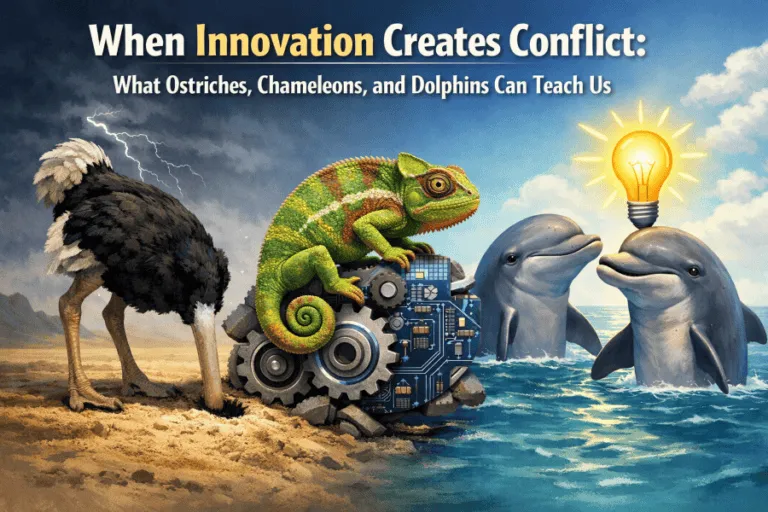
Innovation in local government rarely falters because the idea itself is flawed. More often, it runs into trouble because innovation surfaces value conflicts—efficiency versus equity, transparency versus trust, speed versus deliberation. A February 2025 article by Jorrit de Jong, Albert Meijer and David W. Giles, published by the Bloomberg Harvard City Leadership Initiative at the Bloomberg Center for Cities at Harvard University offers a simple and memorable framework for understanding how public organizations tend to respond when those tensions emerge: the ostrich, the chameleon, and the dolphin.
The authors’ central insight is that innovation often struggles not because of technical shortcomings, but because leaders underestimate the values-based disagreements innovation provokes. I’ve encountered all three strategies in practice. Each has taught me something about when innovation stalls, when it advances, and when it truly sticks.
The Ostrich: Avoiding the value conflict
The ostrich strategy pushes forward while downplaying or avoiding conflict al together. I saw this most clearly in our early struggles to change the way we reported department performance to the public. The goal was straightforward: improve transparency, support data-informed decisions, and communicate results more clearly. But beneath the surface were unresolved value tensions. For some departments, the effort felt reductive—flattening complex, relationship-based work into simplified metrics. Others worried about public misinterpretation or that performance data would be used punitively rather than as a learning tool. Because there was strong interest from the city council and commitment from city management, we moved ahead without fully engaging the underlying value concerns. The dashboard functioned, but adoption was uneven. The team that met quarterly to review performance noted ongoing challenges with some of the measures. Those concerns were reported to department directors, but little changed—and the cycle repeated. The lesson was clear: when resistance is rooted in values—avoidance doesn’t eliminate conflict; it simply postpones it.
The Chameleon: Adapting to keep momentum
The chameleon strategy acknowledges conflict just enough to keep moving. This approach proved effective when we wanted to improve the ease and consistency of reporting problems to the city by community residents. Here, the core tension was speed versus capacity. Residents wanted quick responses; departments worried about workload, expectations, and accountability. Rather than forcing a fully formed solution citywide, we experimented. We adjusted categories, refined service-level expectations, clarified internal workflows, and learned as we went. The system evolved through use, and got better and better through refinement. Chameleon strategies don’t resolve value conflicts entirely, but they reduce risk, build confidence, and create space for learning. Sometimes, that’s exactly what innovation needs.
The Dolphin: Learning through engagement
The dolphin strategy intentionally surfaces value conflicts and redesign solutions through collaboration and engagement. A strong example was an effort to use data collected from various sources about short-term rentals in our community and create an online resource center for neighbors to understand short-term rental compliance and report problems.
This effort touched sensitive and competing values: neighborhood stability, property rights, economic opportunity, and regulatory fairness. Instead of rushing to implementation, we invested time in listening, co-design, and iteration. Significant stakeholder feedback shaped the design. Internal collaboration improved policy clarity. Both the technology and the assumptions behind it evolved. The result wasn’t just a better tool—it was greater legitimacy, clearer expectations, and broader acceptance, even among skeptics. While dolphin strategies often require more time upfront, our experience showed that intentional engagement reduced later friction—accelerating implementation over the life of the program.
Choosing the right strategy
De Jong, Meijer, and Giles remind us that innovation leadership is as much about process as product. The take away for public-sector innovators isn’t that one strategy is always right, but that leaders must diagnose the conflict they’re facing. Is it technical or values-based? Is speed essential, or is legitimacy the greater risk?
Ostrich strategies defer value conflict, often at the cost of learning. Chameleon strategies adapt around conflict to maintain momentum. Dolphin strategies confront conflict directly and invest in deliberation and redesign. The art of innovation leadership lies in knowing which approach the moment requires—and having the discipline to shift when the strategy no longer fits.
How do you see ostrich, chameleon and dolphin strategies at play in your innovation work?
The Future Is Uncertain. Your Strategy Doesn’t Have to Be.

Sign up to gain access to our network of innovators to receive updates on emerging trends and AFI research. Stay informed on the forces shaping local government. new snippet of text