Strategic Storytelling for Local Governments | Helping Public Officials Engage, Inform & Build Trust
Budgets are tightening. Expectations are rising. Polarization hasn’t taken a holiday. And AI is reshaping the landscape in ways no one fully understands yet. Decision-making based solely on past experience isn’t enough anymore. That’s why more cities are turning to strategic foresight—not to predict the future, but to prepare for multiple futures, and to make better decisions in the present.
By Will Hampton
December is one of the rare moments in local governmentwhere the pace slows just enough to breathe. It’s when leaders look back at theyear they survived—and start lifting their heads toward the one coming. Andthis year more than most, the future feels like a moving target.
Budgets are tightening. Expectations are rising.Polarization hasn’t taken a holiday. And AI is reshaping the landscape in waysno one fully understands yet. Decision-making based solely on past experienceisn’t enough anymore.
That’s why more cities are turning to strategic foresight—notto predict the future, but to prepare for multiple futures, and to make betterdecisions in the present.
And one of the simplest, most useful tools in the foresightworld is something called the Three Horizons Framework.
The Three Horizons in Plain Language
Here’s the short version:
- Horizon 1 is today—the systems, services, and processes that keep the city running.
- Horizon 3 is the future you want—the emerging system shaped by community values, trends, and next-generation needs.
- Horizon 2 is everything in the messy middle—the pilots, experiments, partnerships, and prototypes that help you move from H1 to H3.
It’s not a crystal ball. It’s a structured way to havebetter conversations about change.
And it works because it makes something big feel manageable. As futurist Hauson Le, put it in our recent conversation, the framework gives leaders a lens to “see how systems are changing over time, what’s losing fit for purpose, and what’semerging that could shape the next era.”
Hauson Le explains the Three Horizons Framework at a local government leadership conference.
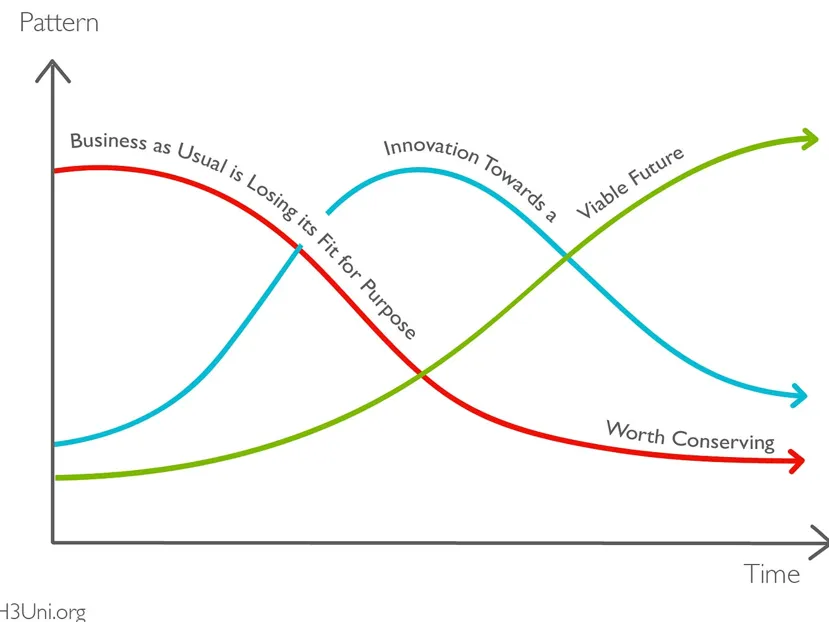
The graphic I’m including below—the one with the threecrossing curves—shows this visually. Business as usual declines. Innovation rises. A new, viable future eventually takes shape.
A key benefit is the order of 1st, 3rd, and then 2nd horizon. When we take time to imagine the future we want, the system ofthe future, the new normal, we then view available partners, practices and innovations with the future operating assumption in mind to help us transition faster. If we don’t do this, innovations can easily and unintentionally perpetuate the status quo.
But here’s the part that matters for local government: all three horizons exist at the same time! You still have to run the city oftoday while preparing for the city you want.
The red line marks Horizon 1: the short-term “baseline” orroughly the next 10 years, i.e. the current system or way of doing things. The blue line is Horizon 2: the mid-term future of transition, 10-20 years out, in which the existing system is breaking down and new approaches are making inroads. The green line is Horizon 3: the long-term future, the next 20 yearsand beyond, in which a “new” system will eventually take root.
Which brings me to a city that’s doing this as well as anyone: the Cityof Fort Collins, Colorado.
How Fort Collins Uses Three Horizons
Plenty of cities do long-range planning. Fort Collins has embedded foresight into how it governs.
Fort Collins created something called the Futures Committee, a group of three councilmembers tasked with stepping away from near-term agendas and examining what’s 10, 20, even 30 years ahead.
The original goal, as Caryn Champine, the city’s Director of Planning, Development and Transportation explained, was simple:
“…to just sort of lift heads up from the (day to day) work and really just see what’s happening out into the world.”
That phrase—lift heads up—became a theme throughout our conversation. In fact, Caryn said one of the biggest benefits of the framework is that it gives councilmembers and staff “permission to lift yourh ead up. It’s OK to think of a different future from what your current work is.”
In a world where inboxes never empty, that’s not nothing.
Training That Stuck
Caryn invited Hauson to present the Three Horizons approachto the committee—and something clicked. Councilmembers immediately started using the language, and senior staff followed.
City Manager Kelly DiMartino told me even months later she routinely hears leaders saythings like:
“OK, well that’s third-horizon thinking … we know we have to get out of first horizon, let’s focus on second horizon.”
Fort Collins then scaled the training to its entire management corps—322 leaders across the organization. The reaction? Surprisingly enthusiastic.
As Caryn put it:
“The basic concepts really resonated … it’s a quick, easy guide to help with more complex conversations.”
Making Foresight Part of Everyday Strategy
Fort Collins now uses the framework in multiple ways:
- Organizational structure: testing pilot reporting changes (Horizon 2) before making big moves (Horizon 3).
- Mobility hubs: identifying a long-term integrated transit vision (H3) and experimenting with a temporary hub now (H2).
- Maintenance operations: helping Horizon 1 teams see how their work connects to future shifts—without feeling threatened.
- Housing Forward Initiative: bringing all departments together to map their contributions across the three horizons, which Caryn described as “really impactful” and “disarming,” especially for staff who live deep in operational work.
The takeaway is simple: the framework isn’t just forvisioning sessions. It’s shaping daily conversations.
Why It Works for Local Government
After talking with Kelly, Caryn, and Hauson—and hearing from city managers at the Washington City/County Management Association conference this summer, where Hauson and I presented on behalf of the Alliance for Innovation—I’m convinced this approach hits several pain points cities are feeling right now.
1. It organizes the messy middle.
Policy issues around housing, climate goals, transportation,and affordability all involve trade-offs. The Three Horizons gives leaders a neutral way to talk about those tensions without finger-pointing.
2. It gives structure to innovation.
Caryn said it best:
“It’s given us more confidence to test ideas now … we’re not changing for the sake of change. It aligns with our forecasting efforts.”
3. It brings everyone into the same conversation.
Different departments often see different futures. This framework gives them shared language.
4. It reduces defensiveness.
Operational teams—your Horizon 1 folks—don’t feel attacked.Their work is acknowledged as essential. That softens the ground for honest future-focused discussion.
5. It helps leaders make disciplined choices.
Fort Collins, like every city, is feeling fiscal pressure. As Caryn said, foresight is helping them build “the discipline to be intentional with every decision and every dollar” as budget realities tighten.
What Local Government Needs Going Into 2026
If the past few years have taught us anything, it’s that reacting isn’t enough. The world is changing too fast—and the pressures on local government aren’t slowing down.
Foresight tools like the Three Horizons framework won’t solve everything. But they will give your team a clearer picture of what’s coming, more confidence to experiment, and a healthier way to talk about change without getting stuck in today.
When I joined Hauson at the WCMA conference this fall, I watched a roomful of city managers lean into this work with real curiosity. They weren’t trying to predict the future. They were trying to prepare for it.
And that’s exactly what good government looks like.
If your team wants to build capacity around foresight or public discourse, I can help you connect with AFI’s training resources—or bring a session to your leadership team. Just reach out.
Onward and Upward.
*Disclosure: I work with Hauson and the Alliance for Innovation (AFI) and SGR on a consulting basis to support local government training and strategicf oresight initiatives.

Sign up to gain access to our network of innovators to receive updates on emerging trends and AFI research. Stay informed on the forces shaping local government. new snippet of text