When Employee Voices Matter | Saline County, KS
Voice Matters: The Cultural Framework for Communication that Actually Connects, is an initiative involving the Saline County, KS Health Department and Wichita State University that combines organizational culture, behavioral science, artificial intelligence, and communication tools to strengthen the connection between employees and leadership.
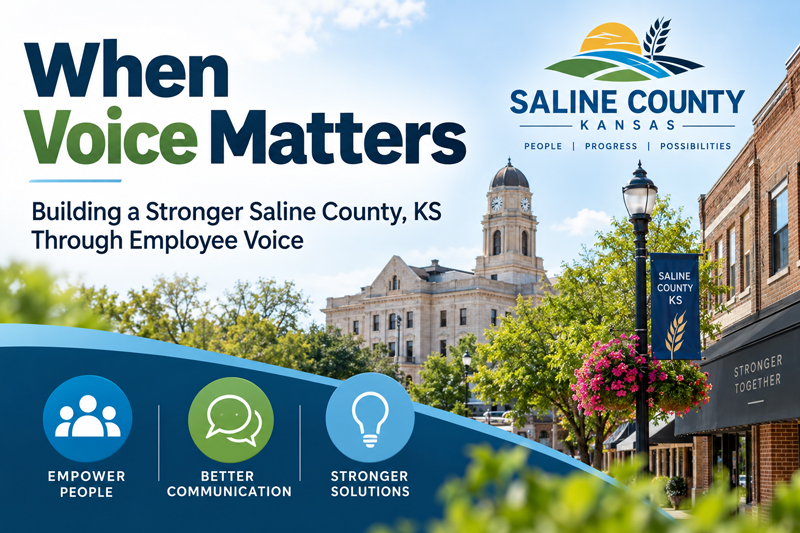
Some of the most valuable ideas in local government never make it to the decision-making table. Front-line employees interact with residents, navigate processes, use organizational systems, and experience operational challenges every day. They are often among the first to recognize when something is not working, or when there may be a better way.
But recognizing a problem and successfully communicating it are two very different things. Fear, organizational hierarchy, unclear communication, and uncertainty about how leadership will respond can keep employees from speaking up. And even when employees do raise an issue, they may struggle to communicate their ideas in a way that resonates with the people they are trying to reach.
That challenge became the foundation for Voice Matters: The Cultural Framework for Communication that Actually Connects, an initiative involving the Saline County Health Department and Wichita State University that combines organizational culture, behavioral science, artificial intelligence, and communication tools to strengthen the connection between employees and leadership.
The premise is straightforward: if local governments want employees to help improve the organization, they must create both a culture in which people feel comfortable speaking and the skills that help them communicate effectively.
The People Closest to the Problem Often See It First
The idea behind Voice Matters emerged from a recurring observation that employees throughout local government see problems, inefficiencies, and opportunities for improvement, but they do not always feel safe or supported enough to raise them. Oftentimes when they do speak up, they may not have the tools to make their message connect with leadership.
Rather than treating this solely as an employee communication problem, the Voice Matters initiative approaches it from both sides of the conversation. The goal is to create an organizational culture that encourages open and respectful dialogue while also helping employees develop the confidence and communication skills necessary to make their ideas heard. The framework grew directly from listening to those frustrations and looking for a way to support organizational change from the inside out.
Telling employees to "speak up" accomplishes little if the culture does not support it. Likewise, creating opportunities for employee input may accomplish little if employees do not know how to frame an issue or communicate an idea effectively. Employee voice requires both opportunity and capability.
Building Change from the Bottom Up
Many organizational change efforts begin at the top. Leaders identify a priority, develop an initiative, and then communicate it throughout the organization. Voice Matters explores another pathway by building capacity from the bottom of the organization up.
The framework is designed not simply to teach a communication technique, but to strengthen a culture of confident, respectful, and productive communication throughout an organization. Employees learn ways to organize their thoughts, understand their audience, and communicate ideas more intentionally.
That creates the potential for a different organizational dynamic. Instead of information primarily flowing downward, insight can move upward and across departments. Employees become active contributors to organizational improvement, while leaders gain greater access to the knowledge and experience already present within their workforce.
For local governments trying to build a culture of innovation, that can be particularly powerful. Innovation does not always come from a new technology, consultant, or executive initiative. Sometimes the solution already exists in the mind of an employee who works with the problem every day. The challenge is creating an organization where that idea can travel.
Using Behavioral Science to Make Communication Connect
Voice Matters also recognizes that communicating information is not the same as communicating effectively. People interpret information through their own experiences, assumptions, priorities, and values. A message that resonates with one audience may fail to connect with another.
The framework incorporates Moral Foundations Theory to help participants think more intentionally about their audience and how a message might be framed so it can be better understood. This does not mean changing the underlying facts or telling different people different stories. Instead, it encourages employees to consider an often-overlooked question: How can I communicate this idea in a way that the person receiving it can understand and connect with?
That shift can be especially valuable in local government, where employees routinely communicate across different professions, departments, leadership levels, and areas of expertise. An analyst, engineer, department director, finance professional, front-line employee, and executive may all look at the same issue through different lenses. Effective communication requires understanding those differences.
AI as a Communication Tool
Artificial intelligence adds another dimension to the framework. Rather than positioning AI as a replacement for employee judgment or communication, Voice Matters uses AI as a tool to help employees organize ideas and craft messages with greater intention.
Imagine an employee who has identified a recurring operational problem but is unsure how to explain it to leadership. AI can potentially help that employee organize the issue, clarify the desired outcome, anticipate questions, simplify technical language, or reframe a message for a particular audience. The employee still provides the knowledge, context, judgment, and idea. Technology helps make the communication clearer.
That represents a practical use of AI that local governments can begin exploring without attempting to fundamentally redesign an entire service. It allows organizations to use technology to strengthen the capabilities of the people already doing the work.
Culture Is Still the Foundation
Technology alone, however, cannot create employee voice. An organization could provide every employee with sophisticated AI tools and communication training and still fail to hear good ideas if employees believe that questioning a process carries personal or professional risk.
That is why trust and culture remain central to the Voice Matters approach. The framework connects communication skills with a broader effort to create an environment where employees feel more confident engaging in respectful conversations about problems and potential solutions. Its aim is not merely to make people better presenters; it is to support a workplace in which productive dialogue can occur across organizational levels.
For leaders, that requires something more than encouraging employees to speak. It also requires demonstrating that the organization is willing to listen. When employees raise concerns, challenge assumptions, or suggest a different approach, the response they receive sends a message to everyone watching. Over time, those interactions help determine whether employees believe their voice truly matters.
Partnerships Strengthen the Approach
The development of the framework has also drawn upon partnerships with professionals in artificial intelligence and organizational culture, along with academic, civic, and other stakeholders. Those relationships bring together interdisciplinary research, real-world data, and the lived experience of government professionals, helping ensure that the framework is grounded in the realities of public organizations rather than remaining purely theoretical.
This collaborative approach reflects another lesson for local government innovation that organizations do not have to develop every solution alone. Universities, professional networks, civic organizations, technology experts, and other partners can bring knowledge and perspectives that complement the experience already inside government.
Application of the Framework by Others
One of the potentially valuable characteristics of Voice Matters is that it was designed to be adaptable. The framework is not tied to a particular department or organizational size. Its modular structure allows components to be introduced in stages and adjusted for different organizational environments. While employee empowerment and leadership development are not new concepts, the initiative seeks to distinguish itself by bringing together communication science, AI tools, and culture-building practices within one framework.
That makes the underlying concept relevant well beyond one organization. Every local government has employees with institutional knowledge. Every organization has communication barriers. Nearly every organization has experienced a moment when someone said, "We knew this was a problem."
The more important question is whether the organization had a way for that knowledge to reach the right people before the problem became larger.
From Employee Voice to Organizational Capacity
Ultimately, Voice Matters is about more than communication. It is about organizational capacity. A local government becomes stronger when employees throughout the organization can identify challenges, think critically about solutions, communicate effectively across organizational boundaries, and trust that constructive ideas will be considered.
The framework therefore points toward a broader definition of an innovative organization. Innovation is not simply the ability to generate new ideas. It is the ability to surface those ideas, communicate them, evaluate them, and act on them, regardless of where in the organization they originate.
When front-line knowledge can reach leadership, when leaders create space for respectful dialogue, and when employees have the tools and confidence to communicate effectively, organizations become better positioned to learn and adapt.
In an environment where local governments face increasingly complex challenges, that ability may be one of their most important competitive advantages. Because sometimes the next great idea for improving local government is already inside the organization. The first step is making sure it can be heard.
For more information contact on this case study contact Candice Sauers, Deputy Director, Saline County, KS Health Department at sauersc@salinecountyks.gov or Aaron Davis, WSU Center for Public Health Initiatives at aaron.davis@wsu.edu.

Sign up to gain access to our network of innovators to receive updates on emerging trends and AFI research. Stay informed on the forces shaping local government. new snippet of text