The day before the Transforming Local Government Conference opened in Dallas, a room of local government leaders spent a morning learning to think like futurists—mapping horizons, digging beneath the surface of stubborn problems, and building plausible pathways to a preferred future. Powerful tools. But they share a quiet limitation: a handful of leaders in a hotel ballroom, however sharp, is still a handful of leaders.
The hardest questions facing local government—housing, workforce, fiscal sustainability, the fraying of public trust—are too big for any city hall to answer alone. So on Tuesday afternoon, a four-hour workshop picked up exactly where the pre-conference left off and pushed the door open wider. Participatory Foresight: Shaping Futures with Community, led by AFI Strategy Director Hauson Le and Foresight Vector founder Steven Kenney, asked a deceptively simple question: what if residents weren’t just consulted about the future, but helped author it?
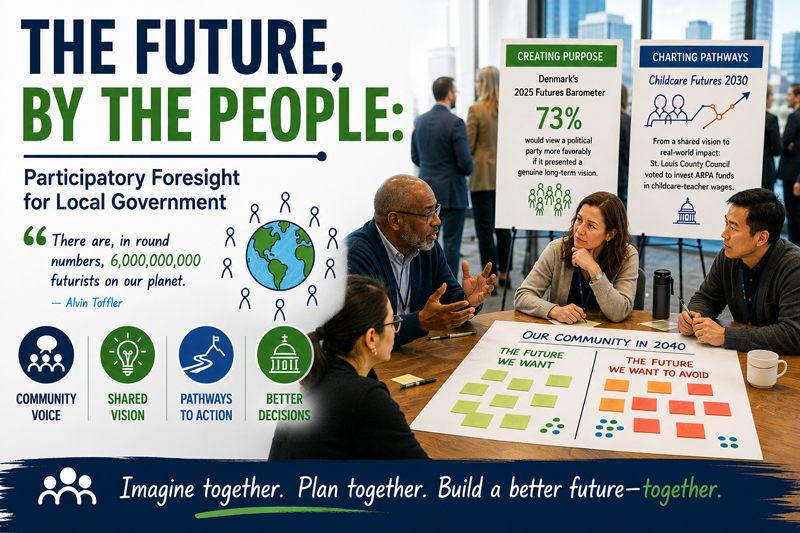
“There are, in round numbers, 6,000,000,000 futurists on our planet,” reads the Alvin Toffler line the facilitators used to set the tone. “There are so many futurists because every human carries inside her or his skull a set of assumptions about what does not yet exist.” The premise of the afternoon was that those 6 billion assumptions are an underused civic asset.
Not another engagement meeting
Participatory foresight joins two disciplines that local governments know very unevenly. Community engagement is familiar ground—every city runs some version of it. Strategic foresight is not: it remains a specialized practice, still working its way into the local government mainstream, and one the Alliance for Innovation and Hauson Le have been actively championing. (It was the subject of the pre-conference workshop covered here. Bringing that less-familiar discipline together with the everyday one is what defines participatory foresight—and also what makes it easy to mistake for the public-input process every city already runs. The difference is worth stating plainly.
Conventional engagement tends to focus on what is—the problems and complaints of the present and near term. Residents are usually handed options already framed for them and asked to react, one comment card or survey response at a time. Participatory foresight inverts each of those moves. It focuses on what could be, over a longer horizon. It treats residents as co-authors of a shared vision rather than reviewers of a finished one. And it is built to surface collective intelligence, not just aggregate individual opinions.
The case for doing this, the facilitators argued, is not sentimental. Engaging more people in thinking about the future tends to produce better decisions: a wider range of perspectives guards against blind spots, lends legitimacy to hard choices, and—not least—helps rebuild the institutional trust that so many communities have lost. When residents help imagine the future, the future starts to feel like something shared rather than something done to them.
Two exhibits that made it concrete
The heart of the workshop was a gallery of real case studies—poster-sized exhibits attendees walked, discussed, and marked with colored dots (red for most useful in my community, blue for most feasible). Two of them showed the range of what this approach can do.
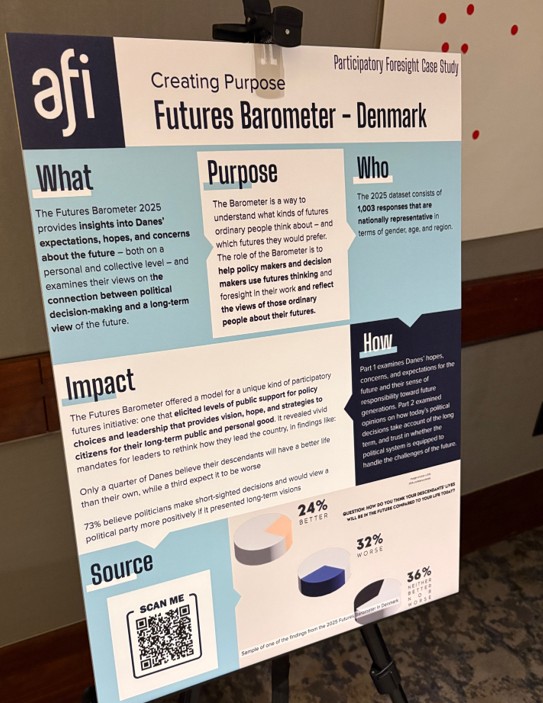
The first, filed under Creating Purpose, came from Denmark. The 2025 Futures Barometer surveyed a nationally representative sample of just over a thousand Danes about their hopes and fears for the future—and the results were sobering. Only about a quarter believed their descendants would live better lives than they do; a third expected worse. But buried in the same data was a striking mandate for leaders willing to think long term: 73 percent said they would view a political party more favorably if it presented a genuine long-term vision. Far from being naïve, the exhibit suggested, foresight is what the public is asking for.
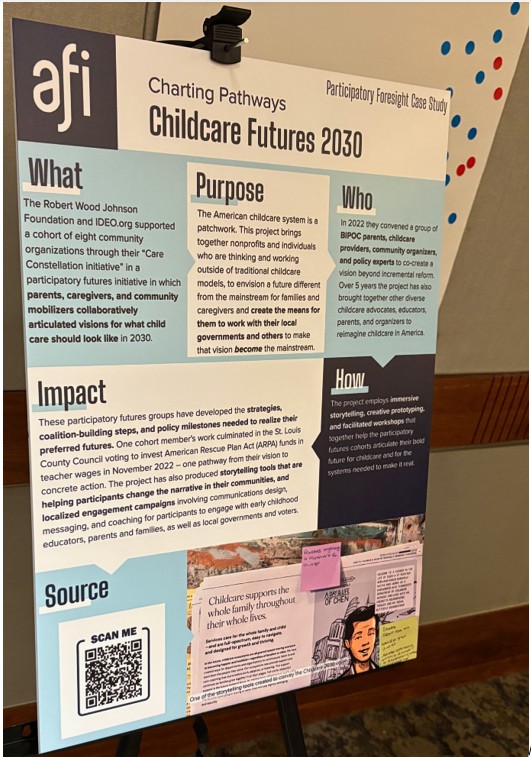
The second exhibit, under Charting Pathways, answered the skeptic’s inevitable question—does any of this lead to action? The Childcare Futures 2030 project, backed by the Robert Wood Johnson Foundation and IDEO.org, convened parents, providers, community organizers, and policy experts to imagine a childcare system beyond incremental reform. It did not stop at a vision. One cohort’s work traced a direct line to the St. Louis County Council voting to invest American Rescue Plan Act funds in childcare-teacher wages—a concrete pathway from a shared future to a line in a public budget.
Together, the two posters made the abstraction tangible: participatory foresight can clarify what a community values and move real dollars and decisions.
A room willing to wrestle with it
To its credit, the workshop did not oversell the method. The honest friction in the room was part of the lesson.
The afternoon opened with an “open house” exercise built around a single framing question—Cross-Government Learning in 2040—that fanned out across the room into paired prompts: the future participants wanted to create and the one they wanted to prevent; the changes today pushing their organizations toward that future and away from it; and what from the past they needed to bring with them versus let go of. Attendees wrote on sticky notes and clustered them with like ideas. Not everyone found it natural. “I wanted to have conversations,” one participant said, “so it felt a little off to just go put sticky notes on the wall.” The walls also surfaced real disagreement rather than tidy consensus. Several of the notes on what to let go of named DEI—reflecting a view that seemed widely shared in the room, that the term had come to feel more performative than practical. That reading didn’t go unchallenged: one participant pushed back, arguing that the room shouldn’t run away from the words, or the commitment behind them. No one resolved it on the spot, and that was rather the point. Participatory foresight is designed to make tensions like this visible, not to smooth them away.
The questions that followed were equally unvarnished. Is this a slide toward direct democracy? (The facilitators’ answer: informed participation requires some education, so residents aren’t just offering pie in the sky—but there is also real value in freeing people to think without constraints. You need both.) And in a pointed reminder, one veteran facilitator noted that evening meetings tend to draw the same retired regulars; genuine participation means providing childcare, transportation, and support so the room is more representative of the community. The method, in other words, is only as good as who gets to be in it.
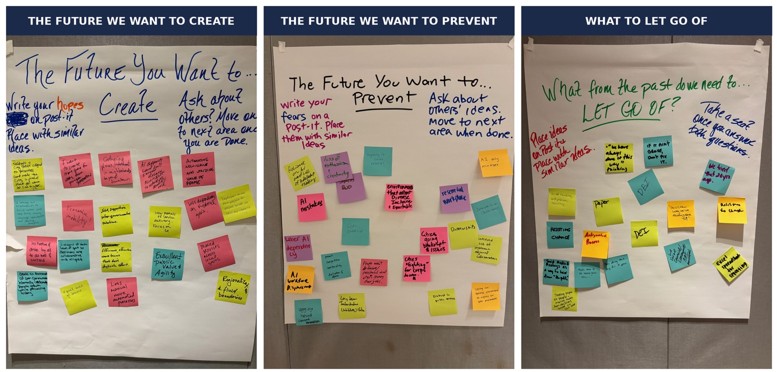
Caption: A slice of the opening “Cross-Government Learning in 2040” exercise. Working from a single question, participants sorted their thinking onto flip charts—the future they hoped to create, the one they wanted to prevent, and what they needed to let go of to get there. The honesty was the point: alongside aspirations like shared services and “excellent public value,” the walls filled with candid fears (AI displacing judgment, cities going bankrupt, a “resentful workplace”) and habits to release (“we’ve always done it this way,” “if it ain’t broke, don’t fix it”).
Alt text: Three flip-chart posters photographed side by side, each headed with a handwritten prompt and covered in colorful sticky notes. The left poster, “The Future You Want to Create,” holds notes such as “shared services across local govts,” “economic mobility,” and “excellent public value & agility.” The center poster, “The Future You Want to Prevent,” holds notes such as “AI mistakes,” “cities going bankrupt / $ issues,” “decreased trust,” and “resentful workplace.” The right poster, “What from the past do we need to let go of?,” holds notes such as “we’ve always done it this way,” “if it ain’t broke, don’t fix it,” “unnecessary red tape,” and “we tried that 20 yrs ago.”
Bringing it home
If the exhibits showed what’s possible elsewhere, the workshop’s final task asked attendees to make it local: identify a challenge in your own community where participatory foresight might fit, and pitch it to a partner.
As the facilitators put it, quoting futurist Thor Svanholm Gustavfson: “Embedding participatory foresight may be one of the most effective ways to shift ownership of the future from governments alone to society at large.”
Why this fits the work AFI does
Since 1979, the Alliance for Innovation has helped local governments think differently, act boldly, and lead through change—spending more than four decades serving those at the forefront of the field with an enhanced capacity to anticipate, adapt, and build better communities. That capacity is precisely what participatory foresight is built to strengthen. Innovation capacity is what allows local governments to stay resilient, adaptive, and forward-thinking: to anticipate change, respond to emerging challenges, and deliver meaningful improvements for the people they serve. Strategic foresight equips leaders to explore what’s ahead, make sense of uncertainty, and act with intention rather than simply react—and participatory foresight extends that same discipline to the whole community.
For leaders ready to try it, the invitation from Dallas was to start small and keep the conversation going—through AFI’s ongoing Foresight Certification, Member Meetups and its regular newsletter, where this work continues long after the conference floor empties.

Sign up to gain access to our network of innovators to receive updates on emerging trends and AFI research. Stay informed on the forces shaping local government. new snippet of text