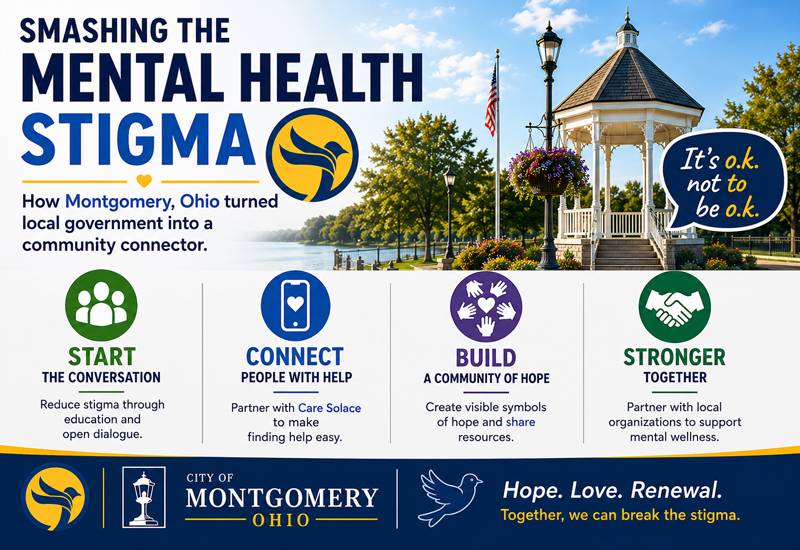
Smashing the Mental Health Stigma: How Montgomery, Ohio Turned Local Government into a Community Connector
Mental health challenges do not stop at the doors of city hall. They affect employees, families, first responders and residents across every community. For the City of Montgomery, Ohio, recognizing that reality led to an important question: What role can a small local government play in supporting mental wellness when it is not a healthcare provider?
Mental health challenges do not stop at the doors of city hall. They affect employees, families, first responders and residents across every community. For the City of Montgomery, Ohio, recognizing that reality led to an important question: What role can a small local government play in supporting mental wellness when it is not a healthcare provider?
Montgomery’s answer was not to become a mental health provider. Instead, the City embraced something local government already does well—bringing people together, building partnerships and connecting residents with resources.
The result is a multifaceted mental health initiative designed to reduce stigma, encourage conversations and make it easier for people to find help when they need it.
From Community Concern to Organizational Priority
Montgomery’s focus on mental health began before the COVID-19 pandemic. A Community Health Assessment completed in 2019 found that residents ranked mental health concerns among the top three issues facing the city. The disruption that followed during the pandemic only increased the need to address mental wellness both within the organization and throughout the community.
The City began internally, offering employees the opportunity to participate in a voluntary four-week mental health support program called “Start the Conversation.” Interest from employees demonstrated a desire to continue learning and talking about mental health, leading Montgomery to expand the effort under a broader initiative called “Continue the Conversation.”
The program grew to include Lunch-N-Learns and presentations addressing a range of mental health topics. The City then expanded those conversations beyond its workforce and into the community.
Topics have included understanding mental health challenges and stigma, suicide prevention, managing anxiety and depression, and Critical Incident Training. The City has also hosted three mental health fairs that brought speakers and many local providers under one roof.
Community educational opportunities were expanded to include nationally known speaker Kevin Hines to share his experience surviving a suicide attempt from the Golden Gate Bridge, along with powerful panel discussions about suicide, addiction, and substance abuse. The panelists consisted of people who have personally been affected by those conditions. The City of Montgomery continues its commitment to mental health awareness by welcoming former Major League Baseball player and mental health advocate Drew Robinson for a special community presentation on Thursday, October 29, 2026.
Making It Easier to Find Help
Education and conversation were only part of Montgomery’s approach. City leaders also recognized a practical challenge: even when someone decides to seek mental health care, figuring out where to go can add stress to an already difficult situation.
In June 2024, Montgomery partnered with Care Solace, a service designed to connect residents with mental health and substance-use treatment providers regardless of insurance coverage. The City promotes the service through its newsletter, website, social media and, importantly, its first responders.
Police and other first responders are provided with cards containing a QR code and phone number so they can connect individuals with the service.
Early results demonstrated the demand. According to Montgomery's case study submission, following the launch, Care Solace handled 6,428 service referrals and requests, with an average of 1.5 days to match an individual with a mental health provider and 10.5 days to the first appointment. The most common needs included anxiety, depression, trauma and stress, and suicidal ideation or self-harm.
Creating a Visible Symbol of Hope
Montgomery also understood that reducing stigma requires making mental health part of everyday community conversation.
The City created a bluebird logo to brand its mental health efforts. The bluebird was chosen because of its association with hope, love and renewal. The symbol began appearing throughout Montgomery on yard signs, T-shirts, refrigerator magnets, bracelets and other materials containing mental health resources and crisis contact information.
The branding helped transform the initiative from a collection of programs into a recognizable community message: mental health matters, talking about it is encouraged, and resources are available.
As Montgomery summarized the central message of its initiative: “It's o.k. not to be o.k.”
Innovation Through Convening
One of the most valuable lessons from Montgomery’s experience is that innovation does not necessarily require creating an entirely new service or building a large new program.
The City does not have healthcare or mental health professionals on staff. Instead, it identified its strength as a convener.
Through networking and direct outreach, Montgomery assembled mental health professionals, nonprofit organizations, clinicians, treatment centers and other community partners. Each connection helped generate another opportunity, allowing the initiative to grow without requiring the City to become a service provider itself.
Strategic partnerships have been essential. Hamilton County and Duke Energy provided grant funding, while a local senior living facility and two churches offered space for mental health fairs and community presentations. Care Solace brought specialized navigation services, and local mental health professionals contributed their expertise to help launch and sustain the effort.
Montgomery also secured a $3,700 stipend through Hamilton County's “We Thrive Initiative” and a $5,000 Duke Energy Foundation grant supporting its work, including bringing Kevin Hines to the community.
A Model Small Communities Can Replicate
Perhaps the strongest aspect of Montgomery's approach is its scalability.
Montgomery is a small city with a lean staff. Its experience demonstrates that communities do not necessarily need a large budget or dedicated mental health department to make an impact. An initiative can begin with an employee conversation, a community presentation, a partnership or simply identifying and promoting resources that already exist.
The City's work has generated interest from other communities. Montgomery's Mental Health Team presented the initiative at the 2023 ICMA Conference and subsequently received invitations to speak at additional conferences and inquiries from municipalities interested in developing similar efforts.
The lesson for other local governments is straightforward: you do not have to provide every service to make a difference.
Local government occupies a unique position of trust and connection within a community. By using that position to convene partners, normalize conversations, connect people with professional resources and make mental wellness visible, cities and counties can become catalysts for healthier communities.
Montgomery's initiative started with a willingness to have a conversation. Its experience shows just how far that conversation can go.
For more information contact Matthew Vanderhorst, Community and Information Services Director, City of Montgomery, OH at mvanderhorst@montgomeryohio.gov.

Sign up to gain access to our network of innovators to receive updates on emerging trends and AFI research. Stay informed on the forces shaping local government. new snippet of text