Five Leaders Exploring What’s Next for Local Government
What do local government leaders choose to explore when committing the time and space to think beyond the pressures of today? Explore how five local government leaders are applying strategic foresight to challenges already shaping the future of their organizations and communities.
Five Leaders Exploring What’s Next for Local Government
What do local government leaders choose to explore when committing the time and space to think beyond the pressures of today?
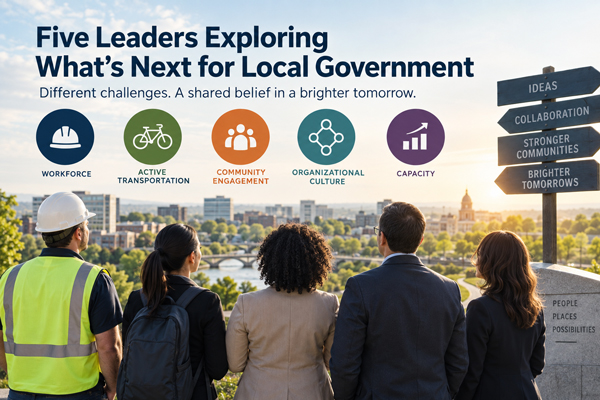
This summer, five public service professionals completed the Alliance for Innovation’s Fundamentals of Foresight course, applying strategic foresight to challenges already shaping the future of their organizations and communities. Their research explored the future of the blue-collar workforce, organizational culture risks, community engagement, active transportation, and the capacity of local government.
While their topics differed, each project started from asimilar premise: the future is not something local governments simply prepare for. The choices leaders make today can influence what becomes possible tomorrow.
The Future of the Blue Collar Workforce
Cory Styron explored why blue-collar workforce shortages should be treated as along-term strategic challenge rather than a temporary recruiting problem. His research identifies demographic shifts, changing worker expectations, and increasing competition for talent as structural forces reshaping how local governments attract and retain skilled employees. He calls for a shift from filling vacancies as they arise toward continuously developing talent through school partnerships, apprenticeships, internships, technology, and stronger organizational cultures. Ultimately, his work argues that the workforce available in 2040 will depend on the investments and workforce decisions organizations begin making today.
Cory Styron
Director of Community Services, Los Alamos County, New Mexico
Integrating Active Transportation in Overland Park
Kaitlyn Walberg explored how active transportation can be treated as a broader community investment rather than simply an infrastructure project. Her research connects active transportation to reduced emissions ,improved safety, stronger neighborhood connections, and opportunities for innovation. Realizing those benefits will require sustained collaboration among city departments, elected leaders, nonprofits, community stakeholders, and eventually neighboring jurisdictions. Her work proposes beginning with a pilot project and using Overland Park’s capital improvement process to move active transportation from a future possibility toward implementation.
Kaitlyn Walberg
Assistant to the City Manager, Overland Park, Kansas
Building Trust Through Community Partnership
Candice Sauers explored why community engagement should evolve from a communications function into an organization-wide strategy for building trust. Her research identifies changing resident expectations and declining effectiveness of traditional participation methods as signals that local governments need more collaborative approaches to engaging their communities. She calls for authentic partnerships, continuous relationship-building, and greater integration of engagement across departments so residents become active participants in shaping community priorities. Ultimately, her work positions trust, participation, and community partnership as capabilities that local governments must intentionally build and sustain over time.
Candice Sauers
Deputy Director of Public Health, Saline County, Kansas
Preparing Local Government for the Shared CapacityEconomy
Aaron Davis explored why the growing gap between complexity and organizational capacity may require local governments to rethink how they deliver public services. His research suggests that maintaining every capability independently will become increasingly difficult, particularly for rural communities facing workforce and fiscal constraints. He proposes a shift toward shared regional capabilities and new operating models that expand access to specialized expertise while preserving local leadership and decision-making. Ultimately, his work challenges communities to identify the capabilities they may struggle to sustain alone and begin experimenting with regional models before capacity gaps threaten essential services.
Aaron Davis
Director, Center for Public Health Initiatives, Wichita State University,Kansas
Together, these projects demonstrate the range of challenges where foresight can strengthen local government decision-making. Foresight does not provide a prediction of what will happen. It creates a structured way to examine how conditions are changing, explore multiple possibilities, and make more intentional choices in the present.
Completing the research is only one step. The greater opportunity is helping leaders bring this way of thinking into their organizations—facilitating conversations about uncertainty, challenging assumptions, and helping teams translate longer-term possibilities into action.
Continue Your Foresight Journey: Foresight Leadership
Beginning in January, the Alliance for Innovation’s ForesightLeadership for Local Government course takes the next step: moving from learningabout foresight to building the capacity to lead with it.
Over four months, participants learn and apply seven foresight methods while facilitating them within their own organizations. The course is designed for local government leaders who convene people, guide change, and navigate complex challenges—and who want practical ways to help their organizations move from reacting to change toward anticipating and shaping what comes next.
Participants leave with more than a set of tools. They develop experience applying foresight with colleagues, a shared language for navigating uncertainty, and the facilitation skills to strengthen anticipatory thinking across their organization.
The next cohort begins in January 2027. View the Foresight Leadership Certification Course Syllabus here. Register Now.


Sign up to gain access to our network of innovators to receive updates on emerging trends and AFI research. Stay informed on the forces shaping local government. new snippet of text