Case Study: Making a Splash with Smart Stewardship
What if the funding for your next community project is already at work? Staunton, Virginia turned smart cash management into community investment, using earned interest and ARPA funds to cover 72% of a $2.67 million pool house project while minimizing the impact on local revenue.
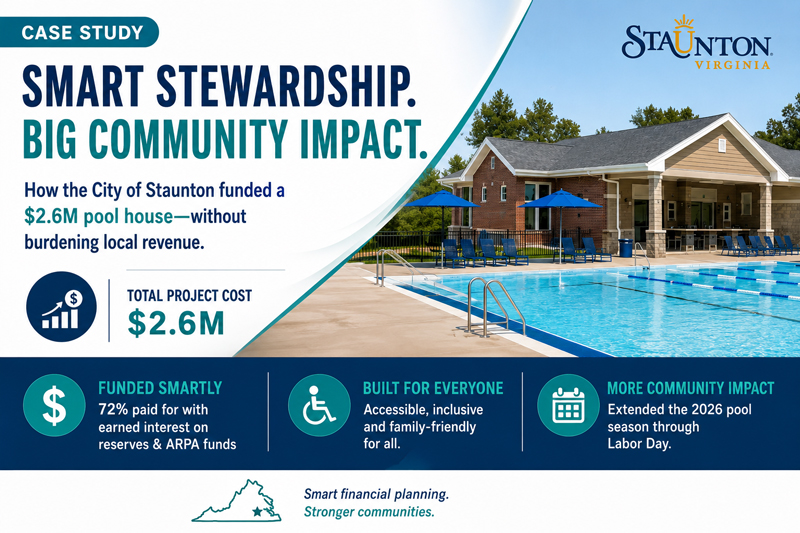
How the City of Staunton Leveraged Earned Interest to Fund a $2.6M Community Asset
The Challenge: A Beloved but Failing Asset
Municipal pools are vital community assets. Their benefits are endless and they serve many functions. They provide affordable recreation, host family and community celebrations, are inclusive gathering spaces, create jobs for our youth, and offer essential water safety instruction. However, the infrastructure supporting them is notoriously expensive to maintain and replace.
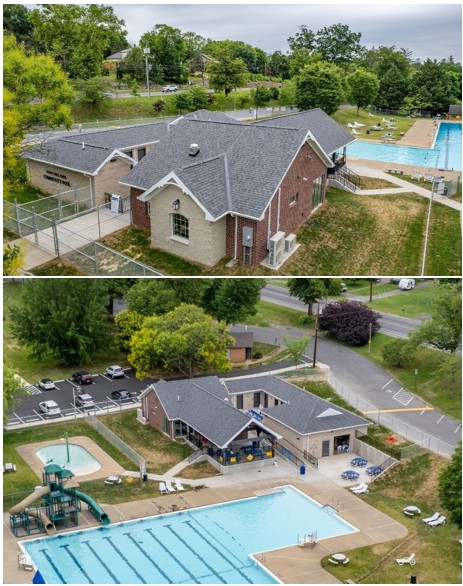
In the City of Staunton, Virginia, the 1958 Gypsy Hill Park Pool House had reached the end of its functional life. Beyond structural failures—like corroding steel joists and deteriorating walls—the outdated design presented massive accessibility barriers. Visitors had to navigate stairs or a long, steep ramp just to reach the restrooms, creating a highly restrictive environment for seniors, families with strollers, and individuals with mobility challenges.
We needed a new facility, but we also needed a way to pay for it without placing a heavy burden on local revenue.
The Innovation: Strategic Use of Earned Interest
When local governments consider capital projects, the traditional funding levers are usually bond issuances, direct grant allocations, or general fund revenue. Staunton’s leadership saw an opportunity to think differently about how we managed our federal pandemic relief funds and capital reserves.
Instead of looking only at the principal amounts of our American Rescue Plan Act (ARPA) allocations and Capital Improvement Plan (CIP)funds, we focused heavily on the interest those funds were generating. The city utilizes two investment accounts, the Virginia Investment Pool and its primary banking relationship, to diversify its cash investments and maximize interest earnings while maintaining appropriate liquidity and flexibility.
The total cost for the planning, design, and construction of the new pool house was $2,670,596. Rather than draining local coffers, our finance team funded 72% of the project using a combination of federal ARPA funds and the strategic interest earned on capital reserves:
- Interest Earned on CIP Reserve Funds: $1,690,211 (63%) (Note: $822,000 of this was interest earned specifically on federal ARPA allocations)
- Local Funding: $744,258 (28%)
- Direct ARPA Federal Funding: $236,127 (9%)
"I'm especially proud of how we were able to make this project happen through thoughtful financial stewardship," said City of Staunton Chief Financial Officer Jessie Moyers. "By putting existing resources to work, we were able to create a facility with improved amenities and true accessibility while being highly mindful of how we use public dollars. It's incredibly rewarding to see careful financial planning turn into a place our families will enjoy for years to come."
The Result: An Accessible Space for the Next Generation
In fall 2025, Staunton demolished the failing structure and opened a completely modernized facility in time for the summer 2026 pool season.
The new single-story facility features:
- Zero-Barrier Access: A ground-level, direct walkway from the parking lot to the pool deck.
- Family-Centric Design: Individual, unisex restrooms providing enhanced privacy and security for all families and guests.
- Modernized Amenities: A covered concession area with improved kitchen facilities and expanded equipment storage.
Because this financial strategy minimized the impact on local revenue, the FY 2027 adopted budget allowed us to extend the 2026 pool season through Labor Day, expanding the community benefits of the new facility.
The Takeaway for Local Governments
While the specific opportunity to earn interest on ARPA distributions is a unique product of the pandemic era, the underlying fiscal strategy is evergreen.
By working closely with your finance team to actively manage reserve funds, forecast interest yields, and purposefully dedicate those earnings to distinct capital projects, municipalities can unlock "hidden" funding streams. Staunton’s new pool house stands as a testament to the fact that smart cash management can directly translate into tangible, accessible, and lasting community infrastructure.
For more information on Staunton, VA’s Pool House please contact Josh Knight, Engagement and Communications Manager, Staunton, VA at knightmj@ci.staunton.va.us.
The Alliance for Innovation welcomes Staunton, VA as one of our newest members. Having a long history as the first Council-Manager form of government, Staunton is a beacon of innovation and servant leadership and we welcome their participation in our Community of Innovators.


Sign up to gain access to our network of innovators to receive updates on emerging trends and AFI research. Stay informed on the forces shaping local government. new snippet of text