Before the Breaking Point | Pre-Resilience
As leaders, we spend a lot of time thinking about resilience and our ability to recover after something difficult happens. But lately, we’ve been thinking about a different idea: pre-resilience. The central question is not simply, “How much can I handle?” It is: What happens when I keep handling it?
By Mike Sable, City Manager, City of Maplewood, MN
There is a particular kind of week that most local government leaders know well.
Nothing goes terribly wrong.
The council packet gets finished. The employee issue gets handled. Someone needs an answer about funding. A resident wants a response tonight. A department head stops by for five minutes. Another meeting gets added because, frankly, it is easier to say yes than explain why you cannot.
And you handle it.
That is the problem.
As leaders, we spend a lot of time thinking about resilience and our ability to recover after something difficult happens. Resilience matters. Local government will always involve storms, elections, conflict, emergencies, budget challenges and the occasional Tuesday that somehow contains three Thursdays.
But lately, we’ve been thinking about a different idea: pre-resilience.
The central question is not simply, “How much can I handle?”
It is: What happens when I keep handling it?
Engineers understand this concept well. Materials do not always fail because of one extraordinary load. They can fail because of a perfectly manageable load applied repeatedly.
The eventual fracture looks sudden. The deterioration that produced it was not.
Leadership can work the same way.
The load that breaks you may be the one you have carried a hundred times.
And because experienced leaders become very good at carrying difficult things, we can actually become harder to diagnose. The work still gets done. People still describe us as capable. Yet something begins disappearing around the edges.
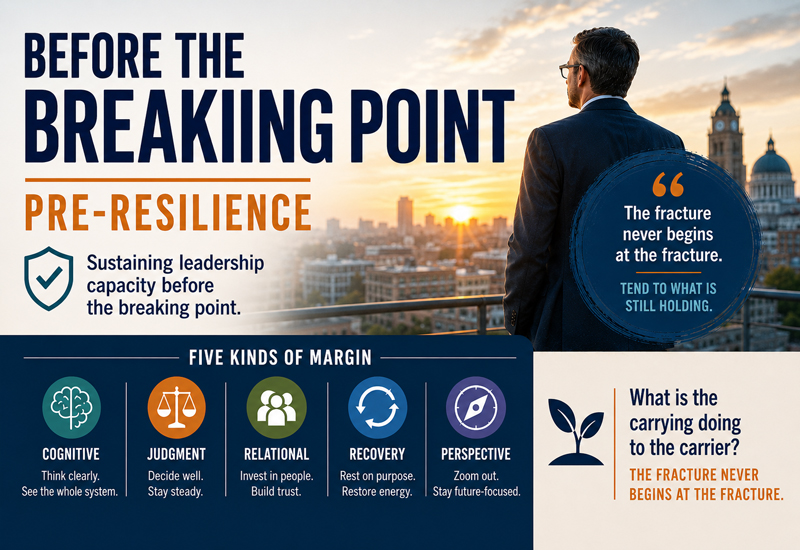
We have started thinking about those edges as five kinds of margin:
- Cognitive
- Judgment
- Relational
- Recovery
- Perspective
You answer faster but think less. Ambiguity becomes annoying rather than interesting. People begin to feel expensive. The weekend happens, but the recovery does not. Everything moves closer to your face until the leader who once saw the whole system can only see what is immediately in front of them.
Your performance may be the last thing to fail.
There is an organizational dimension to this, too. Competence attracts load. When something is not working, capable people compensate. Vacancies, conflict, political complexity, unclear decision rights; we absorb the difference. And because we keep succeeding, the organization receives no signal that something is wrong.
Sometimes the lesson is not that the leader needs more capacity.
Sometimes the job needs redesign.
That brings us to the idea we will explore this fall at the ICMA Annual Conference in Long Beach: local government already knows how to manage important things that deteriorate under load. We maintain reserves. We forecast demand. We inspect condition. We build redundancy. Weintervene before failure.
Maybe we should apply some of that thinking to leadership.
Because our capacity may be personal, but the judgment it produces affects employees, councils and communities.
Judgment is public infrastructure.
If you are headed to ICMA, we hope you will join Corri Spiegel, Phil Kirarly and me for Building Presilience: Sustaining Leadership Capacity Before the Breaking Point.
And if these are the kinds of conversations your organization needs more of, consider joining the Alliance for Innovation. The Alliance is at its best when local government innovators learn from one another, test ideas together and challenge the assumptions that quietly become “the way we do things.”
Until then, one question is worth carrying with you:
What is the carrying doing to the carrier?
The fracture never begins at the fracture.
Tend to what is still holding.
Mike Sable will be at the ICMA Conference to present Building Presilience: Sustaining Leadership Capacity Before the Breaking Point in Long Beach, California during the 2026ICMA Conference. Sable is also a member of the Board of Directors for the Alliance for Innovation.

Sign up to gain access to our network of innovators to receive updates on emerging trends and AFI research. Stay informed on the forces shaping local government. new snippet of text