Building a Culture of Continuous Improvement: Elk Grove’s AIM Academy
The City of Elk Grove, California’s Always Improving Mindset (AIM) Academy was created as part of the City’s commitment to operational excellence and continuous improvement. The Academy equips employees with practical tools to identify waste, reduce delays and duplication, improve processes, and strengthen service delivery.
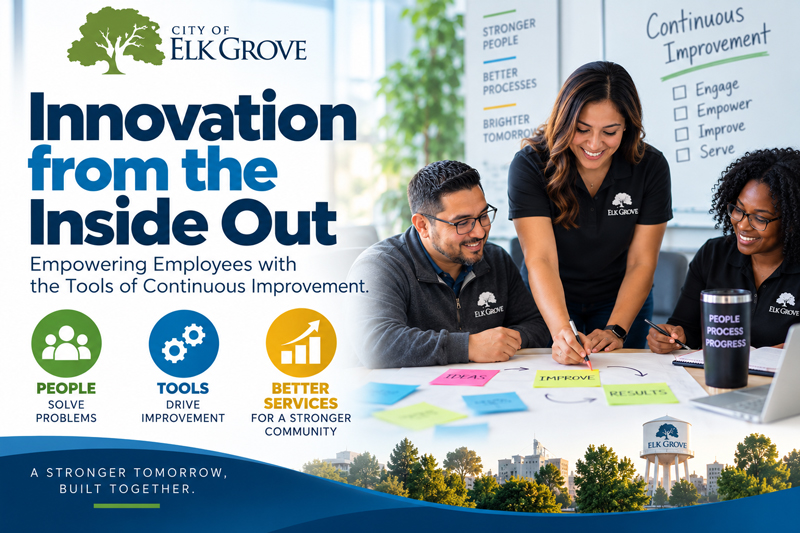
Some of the most meaningful innovation comes from rethinking how everyday work gets done. That idea is at the heart of the City of Elk Grove, California’s Always Improving Mindset (AIM) Academy. Created as part of the City’s commitment to operational excellence and continuous improvement, the Academy equips employees with practical tools to identify waste, reduce delays and duplication, improve processes, and strengthen service delivery.
Rather than relying on outside experts, Elk Grove chose to build that expertise from within, training employees to become change agents in their own departments.
The approach demonstrates an important lesson for local governments: sustainable innovation is not just about finding better solutions, it is about building the capacity of employees to continually find better ways of working.
Starting with a Problem Worth Solving
Elk Grove's AIM Academy grew from the City's broader commitment to operational excellence and continuous improvement. Like many local governments, the City saw opportunities to improve processes that crossed departmental boundaries, and recognized a chance to build organizational capability, not just fix isolated problems.
The goal was not to complete a handful of improvement projects. It was to equip employees throughout the organization with Lean Six Sigma[CW1.1] and other tools to recognize inefficiencies, analyze processes, and implement lasting solutions.
When continuous improvement is treated as a project, it often ends when the project does. When it becomes a workforce capability, employees can continue identifying opportunities long after the initiative itself has wrapped up.
Learn Before You Build
The City was selected for Bloomberg Philanthropies’ Innovation Training Program, which promotes people-centered, impact-driven, and iterative approaches among city employees. Additionally, two[CW2.1] employees were sent to Denver's Peak Academy to study an established municipal innovation model. Those employees also completed Green Belt training online, combining exposure to another government's experience with formal process-improvement expertise.
That combination became an important part of Elk Grove's strategy. Rather than simply copying another city's program, Elk Grove learned from a proven approach and then adapted those lessons to fit its own organizational culture and challenges.
It is a practical lesson for any local government pursuing innovation: Replication does not have to mean duplication.
Cities can learn from what has worked elsewhere, understand the principles behind that success, and then design an approach appropriate for their own employees, organization, and community.
Turning Employees into Change Agents
The AIM Academy's most important feature may be who owns the improvement process. Rather than a top-down consulting model, Elk Grove built a practitioner-led training environment where employees become certified change agents within their own departments making process-improvement methods accessible to frontline staff.
That democratizes innovation. Employees closest to a service usually understand the frustrations best: where customers wait, where work is duplicated, which handoffs are unnecessary, and which steps survive only because "that's how we've always done it." Giving them tools to examine and improve their own work unlocks a deep well of organizational knowledge and it means innovation is no longer the exclusive job of an innovation office, analyst, executive team, or outside consultant. It becomes something anyone and everyone can do.
Building a Common Language for Improvement
Lean Six Sigma offers more than technical tools, it gives employees a shared language for examining how work gets done. Instead of calling a process "inefficient," they learn to map it. Instead of assuming they understand a problem, they learn to locate where waste, delays, or unnecessary steps occur. Instead of jumping to solutions, they learn to identify the root of the problem first.
That discipline matters because organizational innovation doesn't always require dramatic change. Often the biggest gains come from hundreds of smaller improvements that make work easier for employees and service better for residents.
Innovation Through Collaboration
Elk Grove also looked beyond its own walls. While developing the Academy, the City reached out extensively to communities with established innovation academies, gaining insight into curriculum, implementation challenges, and practices already tested elsewhere; relationships Elk Grove credits with helping it avoid pitfalls and move faster.
That peer-learning approach has since grown: Elk Grove now includes participants from neighboring public agencies in its training cohorts. In this way, AIM builds two kinds of capacity at once — internal, as employees learn to improve their own organization, and external, as governments learn from one another and spread what works across organizational lines.
Three Ingredients for Replication
Elk Grove believes the academy concept can be adapted by other local governments. The City's experience, combined with models such as Denver's Peak Academy and Bend's Spark!, suggests that the approach can work across different municipal environments.
Three elements stand out as particularly important:
1. Secure leadership commitment. Employees need to know that improvement is backed by leadership and that they have permission to question existing processes.
2. Invest in employees. Building internal expertise requires training, tools, certification, and opportunities for employees to apply what they learn.
3. Start with quick wins. Early, visible improvements build credibility, and momentum for broader change.
These principles make the concept particularly relevant for governments that may not have the resources to establish large innovation departments or continuously engage external consultants.
The academy itself becomes a way to build innovation capacity from within.
From Process Improvement to Culture Change
The Academy's biggest impact may not be any single innovation project, but it's the culture that forms when employees start looking at their work differently. Picture an organization where people routinely ask: Why does this work this way? Where is the customer waiting? Are we doing work that adds no value? Could another department already be doing this? Is there a simpler way? What can we learn from another community?
Those questions are the foundation of continuous improvement. Give employees both the permission and the skills to answer them, and innovation stops being an occasional initiative and becomes everyday behavior.
Building the Capacity to Keep Improving
Elk Grove's experience offers a reminder: innovation capacity can be built, taught, practiced, and shared. The AIM Academy is ultimately an investment not just in improving processes, but in people, giving them the tools to identify problems and the power to solve them.
That may be the most sustainable form of innovation of all. Instead of continually searching outside the organization for the next solution, local governments can build organizations full of people who already know how to find, test, and implement better ways of working. Perhaps that's the real meaning behind Elk Grove's Always Improving Mindset: improvement isn't a destination or a one-time initiative, it's a capability, and a culture, an organization builds on purpose.
For more information on this case study contact Aishwarya Kumar (Ash), Senior Management Analyst/Office of Civic Innovation and Sustainability, City of Elk Grove, CA at akumar@elkgrove.gov.


Sign up to gain access to our network of innovators to receive updates on emerging trends and AFI research. Stay informed on the forces shaping local government. new snippet of text