AI Is Already Here: What Fire Service Adoption Tells Us About the Future of Local Government
A recent strategic scan from the Center for Public Safety Excellence (CPSE) Center for Innovation, examines how artificial intelligence is being used across fire and emergency service operations, training, and administration. The findings reveal an organization-level challenge that extends well beyond the fire service: AI adoption appears to be moving faster than AI governance and organizational capacity.
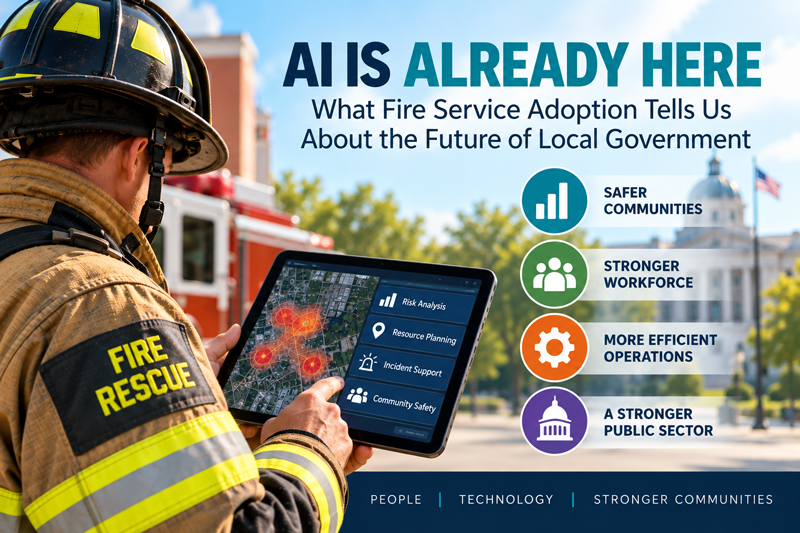
Artificial intelligence is no longer simply an emerging technology that local governments can plan to address someday. It is already in use within our organizations.
The more important questions now are where is it being used, what value is it creating, what risks are organizations encountering, and are governments building the policies and workforce capabilities necessary to use it responsibly?
A recent strategic scan from the Center for Public Safety Excellence (CPSE) Center for Innovation, in partnership with Marist University, provides an interesting window into those questions. Based on responses collected from fire chiefs in July 2025, the research examines how artificial intelligence is being used across fire and emergency service operations, training, and administration.
The findings reveal an organization-level challenge that extends well beyond the fire service: AI adoption appears to be moving faster than AI governance and organizational capacity.
Nearly 79% of responding fire chiefs reported some use of AI, yet only 14% reported having formal departmental AI policies. That gap may be one of the most important findings in the study, and one local government leaders throughout the organization should be paying attention to.
AI Adoption Is Broad but Not Necessarily Deep
At first glance, the level of AI adoption is striking. But looking deeper into the findings reveals a more nuanced picture. Only 7% of fire chiefs reported using AI "to a great extent." Most described their usage as either "somewhat" or "very little." Among chiefs who were using AI, 59% described themselves as comfortable with the technology, while 18% expressed some level of discomfort.
In other words, AI has entered the organization, but it has not necessarily become deeply embedded in how the organization operates. There is a significant difference between employees experimenting with generative AI to draft documents and an organization integrating artificial intelligence into core operational systems and decision-making.
The study suggests that many fire departments are still navigating that transition.
Administration Is the Gateway to AI
One of the clearest findings is where AI adoption is occurring. Among departments using AI, 88% reported at least one administrative use, compared with 52% reporting an operational use and 29% reporting a training use.
Approximately 69% of all respondents reported using AI in administration, with proofreading and revising documents by far the most frequently identified application. Other uses included drafting policies and procedures, job descriptions, performance evaluations, grants, press releases, speeches, letters and social media content. AI was also being used for research, document analysis, translation, workflow improvements, and integration with tools such as Microsoft Copilot.
That pattern should sound familiar to many local governments. Administrative work presents a relatively accessible entry point for AI because organizations can experiment with applications that potentially save employee time without immediately placing AI in control of high-risk operational decisions.
The lesson may be to start where AI can augment employees rather than replace professional judgment. If AI can reduce the time employees spend drafting, summarizing, searching, organizing, or performing other repetitive administrative tasks, those efficiencies can potentially create more capacity for work that requires human expertise or community engagement.
The Operational Possibilities Are Growing
The study also demonstrates how quickly AI applications can move beyond the office. Fire departments reported experimenting with AI for risk assessment, station placement, vehicle deployment and routing, wildfire forecasting, emergency response, incident management, situational awareness, and after-action reporting.
Approximately 16% of respondents reported using AI to facilitate emergency response, including applications involving 9-1-1 call triage, resource positioning before significant weather events, wildfire detection, and traffic assessment. Another 18% reported using AI in active incident management or after-action functions. Other examples included analyzing turnout and response times, fire behavior modeling, incident-command decision support, RMS-integrated AI, post-incident reports, patient-care narratives, and even AI-assisted ultrasound.
These applications point toward a much larger conversation for local government. As AI moves from helping someone write a document to helping someone interpret conditions, allocate resources, evaluate risk, or support a decision, the potential value increases, but so do the consequences of getting something wrong. That means organizations need to think differently about risk depending on the application.
Training May Be One of AI's Untapped Opportunities
Training represents another developing area. Just over 23%of respondents reported using AI in fire-service training, including simulations, adaptive learning platforms, and analysis of employee performance during or after training activities.
Future applications identified by respondents are even more ambitious including:
· realistic simulations
· virtual and augmented reality for incident command and hazardous materials training
· AI-generated imagery for simulation software
· curriculum development
· training plans informed by analytics and experience
· post-incident training recommendations
For local governments facing workforce shortages, retirements, succession challenges, and growing demands for employee development, this may be an area worth watching closely. AI's value may not only come from automating work. It may also help organizations build the capabilities of the people doing the work.
The Biggest AI Challenge May Be Human, Not Technical
Perhaps the most important findings involve what worries fire chiefs about AI. More than 73% identified concerns associated with data, particularly data quality and privacy. But concern was even greater around people and expertise with nearly 83% identified issues involving AI training, lack of expertise, or ethical use of data. Lack of AI expertise was the most frequently selected concern within that group.
Respondents also raised concerns about AI hallucinations, data verification, poor-quality outputs, removing the human element from analysis, overreliance on AI, loss of common sense and experience, cybersecurity requirements, procurement challenges, cost, and integration with existing systems.
These findings reinforce an important point for local government leaders which is AI implementation is not simply an IT project. It is an organizational change initiative.
Buying access to an AI platform does not create organizational capability. Employees must understand what the technology can do, what it cannot do, what information can safely be entered into it, how outputs should be verified, when human review is required, and where AI should, and should not be used.
Adoption Is Outpacing Governance
While 79% of respondents reported AI use, only 14% reported having formal departmental AI policies which is a significant warning sign. Additionally, only 40% reported having access to AI tools through their government organization. That creates the possibility of what might be called informal AI adoption where employees are discovering and using tools before organizational policies, approved platforms, training, procurement processes, and governance systems have caught up.
For local governments, simply prohibiting AI is unlikely to resolve that challenge. A more sustainable approach is to establish clear expectations around acceptable use, privacy, security, data handling, verification, transparency, human oversight, procurement, and accountability while simultaneously giving employees approved ways to experiment and learn.
The goal should not necessarily be to eliminate risk. It should be to understand and manage risk while enabling responsible innovation.
Start Small, Learn, and Scale
The strategic scan recommends piloting operational AI applications in low-risk, high-impact areas, assessing results before scaling, and partnering with vendors or research institutions when testing more advanced tools. It also recommends expanding hands-on AI training and incorporating ethical AI use into professional development.
That approach provides a useful framework for local governments beyond the fire service. Rather than beginning with the question, "How can we use AI?", organizations might begin with: What problem are we trying to solve? Then determine whether AI is actually an appropriate tool.
A pilot can establish the desired outcome, identify risks, define measures of success, involve the employees closest to the work, test the technology in a controlled environment, evaluate the results, and determine whether the application should be expanded. That creates a pathway from experimentation to organizational learning rather than simply adopting technology because it is available.
What Comes Next Is Already Taking Shape
The future applications identified by fire chiefs provide a glimpse of how quickly this landscape may evolve. Respondents reported plans to explore AI for community risk reduction, pre-planning, 9-1-1 call analysis, station deployment, drones, incident reconnaissance and decision support, accountability, medical reporting, staffing, scheduling, budgeting and forecasting, fire plan review, training simulations, and other applications.
Some departments are even considering organization-specific large language models capable of working across meeting recordings, minutes, financial documents, and other internal information. That represents a significant shift. The first phase of generative AI adoption has largely involved individuals interacting with general-purpose tools. The next phase may increasingly involve AI embedded within organizational systems, workflows, data, and institutional knowledge. That makes the governance conversation even more important.
The Leadership Question Is Bigger Than AI
The CPSE research is careful to note that its findings are a snapshot and are not representative of the entire fire and emergency service. The survey included 156 responses from 799 distributed surveys, drawing from CPSE-accredited agencies and credentialed fire officers.
Still, the findings offer a useful picture of a profession navigating a technology that is changing faster than many traditional organizational systems can respond. That may be the larger lesson for local government.
The question facing leaders is no longer simply whether their organizations will use artificial intelligence. In many cases, employees already are. The leadership challenge is to ensure that organizational capacity, governance, skills, ethics, and strategy evolve alongside the technology.
AI may help employees write faster, analyze more information, identify patterns, improve training, optimize resources, or support increasingly complex decisions. But realizing that potential will require more than technology. It will require organizations that are willing to experiment thoughtfully, learn continuously, establish appropriate guardrails, invest in their people, and remain clear about where human judgment belongs.
Technology will continue to change and evolve. The realmeasure of readiness will be whether our organizations can change with it.
This article is based on the Center for Public Safety Excellence (CPSE) Center for Innovation Strategic Scan entitled Use of an Attitudes Towards Artificial Intelligence inthe Fire and Emergency Service. You can view the entire report on the Alliance for Innovation Member Circle here. Visit the CPSE Innovation Center here.


Sign up to gain access to our network of innovators to receive updates on emerging trends and AFI research. Stay informed on the forces shaping local government. new snippet of text