When Revenue Shrinks but Expectations Don't: What the 2026 Elections Mean for Local Government Services
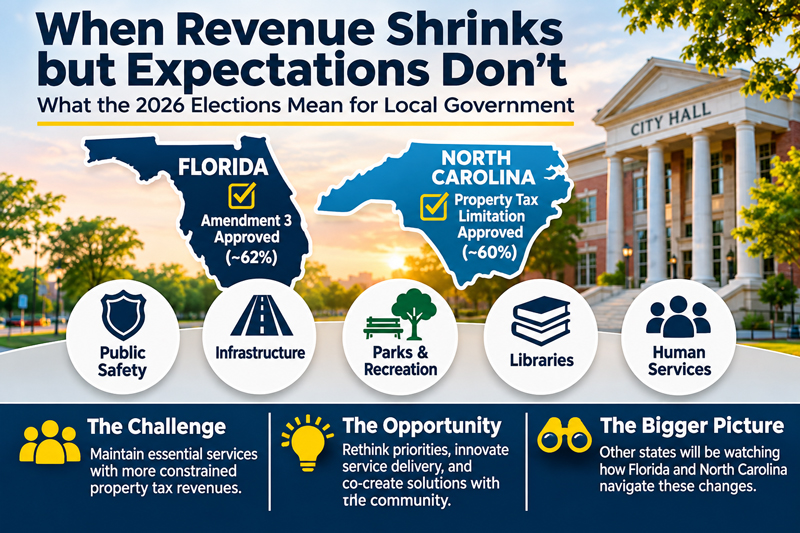
The November 3, 2026, elections delivered a significant message about the future of local government finance. Voters in Florida and North Carolina approved constitutional amendments that will fundamentally change how local governments generate property tax revenue, potentially limiting their ability to keep pace with growing service demands, rising costs, and community expectations.
By Tracy Miller, Vice President of Member Experience, Alliance for Innovation
Property tax changes in Florida and North Carolina could reshape how local governments fund services, engage communities, and prepare for the future.
The November 3, 2026, elections marked a potential turning point for local government finance. Voters in Florida and North Carolina approved constitutional amendments restricting property tax revenues, creating new challenges for communities already confronting rising costs, infrastructure demands, workforce shortages, and increasing expectations for public services.
While the amendments take different approaches, both highlight a fundamental tension: Residents want tax relief, but they also expect safe neighborhoods, reliable infrastructure, responsive services, and a high quality of life.
For local government leaders, the challenge extends beyond balancing budgets. These changes may require a fundamental rethinking of how governments establish priorities, deliver services, engage residents, and demonstrate public value.
Florida: A Fundamental Transformation in Local Government
Florida voters approved Amendment 3 with approximately 62% support. The measure expands homestead property tax exemptions for non-school taxes to $150,000 in 2027 and $250,000 in 2028, with subsequent inflation adjustments. It also reduces the annual assessment growth cap for non-homestead properties from 10% to 5%.
State economists have estimated that the amendment could reduce local government revenues by up to $12 billion dollars annually. Cities, counties, and special districts face significant potential reductions in the property tax base supporting public safety, infrastructure, parks, libraries, and other essential services in addition to internal services such as Human Resources, Finance, Communications and IT.
But the implications extend far beyond revenue losses. Florida local governments may be entering a period of fundamental transformation in how they operate, organize themselves, and deliver services to their communities. This transition comes at a particularly challenging time. Rapid population growth continues to drive demand for roads, utilities, public safety, and public facilities. Established communities face aging infrastructure and deferred maintenance. Meanwhile, rising operating costs, workforce shortages, political polarization, and heightened public expectations complicate decisions about service delivery.
The reality is that Florida local governments may be required to navigate substantial service reductions precisely when their communities are demanding more. Traditional approaches, including across-the-board budget cuts, hiring freezes, and deferred capital investments, may provide temporary relief but can also weaken organizational capacity and create greater long-term costs.
Instead, local governments must reconsider their service delivery models, organizational structures, staffing strategies, capital investments, and community partnerships. Everything is now on the table including contracting for service, public-private partnerships, cost efficiency and effectiveness, automation, consolidation, regionalism and most importantly, service elimination.
Florida as a National Test Case
The implications of Amendment 3 extend beyond Florida's borders. Other states considering property tax limitations will be watching closely to see how Florida communities respond. Can local governments maintain essential services and community quality of life with substantially constrained revenues? Will the changes accelerate innovation and organizational transformation, or result in service reductions, deferred infrastructure investments, and workforce challenges?
Florida's experience may influence property tax policy and local government finance discussions nationwide. The question with national implications is whether local governments can substantially reduce their reliance on property taxes while continuing to deliver the services and outcomes their communities expect.
North Carolina: Constraining Revenue Growth and Local Fiscal Flexibility
North Carolina voters also approved a constitutional amendment addressing property taxes, with approximately 60% voter approval. Unlike Florida's amendment, which directly reduces the taxable property base through expanded exemptions, North Carolina's measure establishes a constitutional requirement for future legislative restrictions on property tax levies.
The specific financial impact will depend on how the General Assembly implements those restrictions, including allowable increases, exceptions, and potential adjustments for growth or extraordinary circumstances.
Property taxes provide a relatively stable and predictable source of funding for many North Carolina counties and municipalities. Restricting future levy increases could limit their ability to respond to inflation, population growth, infrastructure needs, and changes in service expectations.
While the precise effects remain dependent on implementing legislation, the amendment introduces greater uncertainty into long-term financial planning and potentially reduces the flexibility local elected officials have traditionally exercised in balancing service demands with available resources.
Like Florida, North Carolina faces a central challenge: aligning community expectations with financial resources that may become increasingly constrained.
Beyond Budget Cuts: Strategic Service Prioritization
The changes in both states create an opportunity to rethink how local governments establish priorities and allocate resources. Rather than relying primarily on traditional budget reductions, governments can use this as an opportunity to evaluate services based on statutory requirements, costs, performance, strategic alignment, and community value.
This requires asking fundamental questions:
- Which services and outcomes matter most to our community?
- Which responsibilities are mandated, and where do we have discretion?
- What does each service cost, and what results are we achieving?
- Could services be delivered more effectively through partnerships, technology, or organizational redesign?
- What are the long-term consequences of reducing or modifying services?
The objective is not simply to identify what government can eliminate. It is to determine how essential and high-priority services can be preserved, improved, or delivered differently.
Co-Creating the Future With Our Communities
Perhaps the most important opportunity emerging from these constitutional changes is the need to rethink how local governments engage residents in determining the future of public services. The difficult choices ahead should not be made by government alone. They call for co-creation with the community.
Co-creation goes beyond traditional public engagement, where residents express preferences or react to proposed decisions. It brings community stakeholders together to understand challenges, explore alternatives, and collaboratively develop solutions.
Asking residents which services they value is relatively easy. Helping them understand service costs, funding limitations, and the consequences of different choices, creates a more meaningful conversation.
Community surveys, facilitated workshops, interactive budget simulations, and scenario-planning exercises can help residents evaluate real-world trade-offs and identify shared priorities.
An effective approach brings together three perspectives:
- Local Government Staff: Establish the financial and operational realities, create service inventories, evaluate program costs and performance, and identify opportunities for efficiencies, partnerships, and service redesign.
- The Community: Understand financial challenges, evaluate service priorities, consider trade-offs, and help shape alternative approaches to funding and delivery.
- Elected Officials: Integrate professional analysis and community priorities into transparent policy decisions that balance financial sustainability with desired outcomes.
The goal is not unanimous agreement. It is shared understanding, informed decision-making, and greater community ownership of the choices ahead. When residents participate in defining priorities and developing solutions, they become partners in shaping the future rather than simply recipients of service reductions.
Innovation and Performance Excellence: Delivering Greater Public Value
Financial constraints can create pressure for change, but reducing expenditures is not the same as innovation. Innovation requires questioning longstanding practices and exploring better ways to organize, deliver, and evaluate services.
For some governments, this may involve incremental improvements that streamline processes and increase productivity. Others may pursue more transformational approaches, including shared services, regional partnerships, automation, artificial intelligence, and organizational redesign.
Technology alone is not the answer. Meaningful innovation also requires empowered employees, collaborative leadership, and an organizational culture committed to continuous improvement.
Equally important is the ability to demonstrate results. Performance management connects resources to services and measures whether investments are producing desired community outcomes. Local governments should be able to answer three essential questions:
- What are we investing?
- What results are we achieving?
- What happens if our resources change?
These questions provide a stronger foundation for evaluating service reductions, alternative delivery strategies, and long-term investments.
Preparing for an Uncertain Financial Future
The constitutional changes in Florida and North Carolina reinforce the importance of stronger integration of strategic planning, performance management, long-term financial planning, community engagement, and innovation. Local governments can no longer assume that historical revenue patterns will continue. Changes in tax policy, economic conditions, demographics, technology, and community expectations require organizations to prepare for multiple possible futures.
Together, these practices can help local governments move from reacting to financial constraints toward proactively shaping a sustainable future.
A Defining Moment for Local Government Leadership
The 2026 elections represent more than changes to property tax policy. They signal a potentially significant shift in the financial environment in which local governments operate.
Voters seeking tax relief are not necessarily rejecting public services. Many are responding to rising housing costs, insurance expenses, inflation, and broader affordability concerns. Yet expectations for safe communities, reliable infrastructure, and responsive government remain high.
Reconciling these expectations will require honest conversations about what services cost, what results they produce, and what communities are willing to support. It will also require courageous leadership, transparency, innovation, and a willingness to challenge the status quo.
At the Alliance for Innovation, we believe these challenges create an opportunity for local governments to embrace continuous improvement, strengthen community partnerships, and fundamentally rethink how public value is created.
Other states will be watching how Florida and North Carolina navigate these changes. The lessons learned may shape local government finance and service delivery for years to come. The challenge is no longer simply how to do more with less. It is how to co-create a new model of local government with our communities that aligns services with available resources, preserves what residents value most, and builds the capacity to adapt, innovate, and thrive in an uncertain future.
Budget and finance is a topic that will be addressed during the upcoming Transforming Local Government Conference, April 25-28, 2027 in Kansas City, MO. To learn more about the conference Link Here.
Sign up to gain access to our network of innovators to receive updates on emerging trends and AFI research. Stay informed on the forces shaping local government. new snippet of text